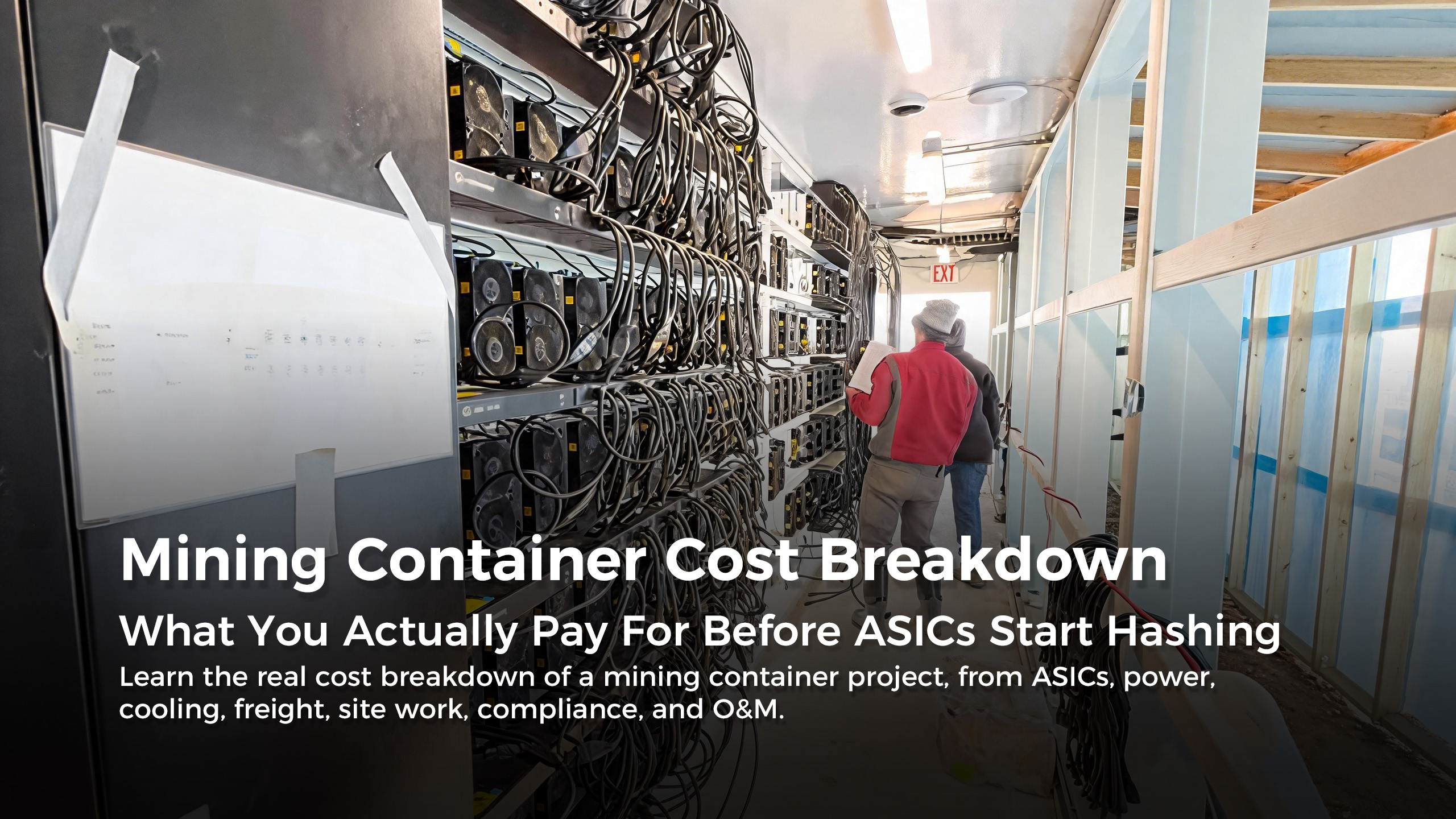
The cheapest mining container quote is usually the most expensive one to believe.
It looks clean in the first email: container shell, fans, racks, maybe a power cabinet, maybe a delivery estimate. The number feels simple. The problem is that mining infrastructure is not simple. By the time the unit is unloaded, wired, inspected, cooled, monitored, and running through bad weather, the original quote may only explain half of the capital actually exposed.
A serious mining container budget has three prices:
Supplier quote. What the factory sells.
Landed cost. What the container costs after freight, port, customs, inland trucking, and unloading.
Commissioned cost. What the project costs when the container is finally powered, inspected, connected, cooled, and ready to produce stable hashrate.
Only the third number belongs in an ROI model.
The Cost Stack: Stop Pricing the Box, Start Pricing the System
A mining container is not a modified shipping container with miners inside. It is a power-to-hashrate system.
The basic cost stack looks like this:
Total Project Cost =
ASIC Miners
+ Container Structure
+ Electrical System
+ Cooling System
+ Monitoring and Controls
+ Safety and Compliance
+ Factory Testing
+ Freight and Insurance
+ Customs and Inland Transport
+ Site Civil Works
+ Transformer and Utility Connection
+ Commissioning
+ Spare Parts
+ First-Year O&M Reserve
The supplier quote may cover only the middle of this stack. The buyer still carries the front end, back end, and site-specific cost.
This is why two containers with the same exterior size can have completely different economics. One may be a low-cost shell with weak airflow and underspecified electrical gear. Another may include proper hot/cold separation, safer power distribution, monitoring, emergency shutdown, filter access, and documentation for inspection.
The first one is cheaper until it reaches the site.
Pro Tip:
When comparing quotes, ask each supplier to mark every line as included, excluded, or optional. The missing items are not free. They are just waiting for you on site.
Cost Layer 1: ASIC Miners Are the Revenue Engine, Not the Whole Project
ASIC miners are usually the largest visible purchase. They are also the easiest cost to misunderstand.
A miner price only makes sense when paired with:
- Hashrate
- Power consumption
- Energy efficiency
- Firmware and control compatibility
- Cooling method
- Warranty terms
- Batch timing
- Import taxes
- Spare hashboards, fans, PSUs, and cables
Mining calculators from platforms like F2Pool and Braiins typically ask for hashrate, power consumption, electricity price, pool fee, and revenue assumptions. That tells you something important: the machine price alone does not define profitability. Power and efficiency decide whether the miner can survive weak hashprice.
For container projects, ASIC cost also changes the infrastructure decision. Older air-cooled units may be cheaper to buy, but they can demand more airflow and may become uncompetitive when hashprice weakens. Newer high-power hydro or immersion miners can deliver better TH per watt, but they require more disciplined cooling, piping, water quality, CDU capacity, and maintenance planning.
Cheap miners can make the container expensive. Efficient miners can justify better infrastructure.
Cost Layer 2: The Container Shell Is the Smallest Part Buyers Overvalue
The steel box matters, but it is not the business.
A 20FT or 40FT container gives the project a transportable structure, weather protection, and a repeatable layout. Standard container dimensions also matter for logistics. DSV lists representative 20FT and 40FT dry container dimensions and capacities, which shows why containerized infrastructure is attractive for global deployment: the format is familiar to shipping, trucking, and yard operations.
But the shell itself is not where ROI is made. The shell becomes valuable only when it supports:
- Correct miner layout
- Service aisles
- Filter replacement
- Cable management
- Intake and exhaust separation
- Safe door access
- Weather resistance
- Lifting and transport integrity
- Long-term corrosion control
A cheap shell can create expensive problems if the structure flexes, seals poorly, traps heat, or leaves no room for maintenance.
Go basic on appearance. Do not go basic on structure.
Pro Tip:
If the container design does not show service clearance, air path, cable route, and power cabinet location, the quoted price is not yet a real infrastructure price.
Cost Layer 3: Electrical System Cost Is Where Serious Projects Separate
Mining containers are electrical rooms with revenue equipment inside.
Electrical cost often includes:
- Main power cabinet
- Breakers and branch circuits
- Busbar or cable distribution
- PDU or socket system
- Grounding and bonding
- Emergency stop
- Surge protection
- Metering
- Control wiring
- Cable trays
- Lighting
- Panel labeling
- Electrical drawings
- SCCR considerations
- Factory test reports
For North American buyers, this layer deserves extra attention. OSHA’s Nationally Recognized Testing Laboratory program explains why recognized testing and certification matter for product safety standards. In real projects, buyers may also need UL/CSA-related components, field evaluation, local electrical inspection, labeling, and documentation.
These costs do not make the miners faster. They make the project deployable.
Skipping electrical discipline can delay grid connection, fail inspection, create nuisance trips, or expose the operator to safety risk. A low-cost container with a weak power system may look attractive until the local authority asks for documentation.
The most expensive container is the one that cannot be energized.
Cost Layer 4: Cooling Cost Is Not One Line Item
Cooling is where mining container quotes become hard to compare.
An air-cooled container may include:
- Intake louvers
- Filters
- Negative pressure fans
- Water curtain or evaporative cooling media
- Exhaust plenum
- Temperature sensors
- Fan control
- Weather protection
- Replacement filters and pumps
A hydro cooling container may include:
- CDU or coolant distribution system
- Dry cooler
- Pumps
- Piping and manifolds
- Valves
- Expansion tank
- Water treatment or filtration
- Sensors
- Leak detection
- Control system
An immersion cooling container may include:
- Tanks
- Dielectric fluid
- Pumps
- Heat exchangers
- Filtration
- Lifting or service tools
- Fluid handling process
- Cleaning and maintenance equipment
The cheapest cooling system is not the one with the lowest purchase price. It is the one that keeps miners from throttling at the lowest total cost per stable TH/s.
Air cooling can be cost-effective in moderate climates and lower-density builds. Hydro cooling can improve control for high-power miners. Immersion can reduce noise and support dense heat loads, but it adds fluid management and specialized maintenance.
Pro Tip:
Ask for cooling cost per stable kilowatt, not cooling cost per container. A low-cost cooling system that loses 5% uptime is not low cost.
Cost Layer 5: Freight, Insurance, and Last-Mile Delivery
Freight is the cost buyers remember only after the purchase order is signed.
Container freight changes with route, season, port congestion, fuel, equipment availability, and shipping market conditions. Freightos publishes container pricing indexes, which is useful because it reminds buyers that freight is a moving variable, not a fixed accessory.
For mining containers, logistics cost may include:
- Export trucking
- Port handling
- Ocean freight
- Marine insurance
- Destination port charges
- Customs clearance
- Import duties and taxes
- Inland trucking
- Escort or special route planning
- Crane unloading
- Temporary storage
- Site rigging
The last mile can hurt more than the ocean freight. Remote mining sites often have cheap land and expensive delivery. Narrow roads, soft ground, limited cranes, low bridges, and weather delays can all increase cost.
This is where 20FT and 40FT decisions matter. A 20FT unit can reduce handling risk in difficult locations. A 40FT unit usually moves more capacity per shipment and can reduce cost per installed kW when the site is prepared.
Go smaller for uncertain access. Go larger for prepared industrial deployment.
Cost Layer 6: Site Civil Works Are Not Optional
The container is portable. The site is not.
A real mining container site may need:
- Grading
- Drainage
- Gravel or concrete pad
- Anchor points
- Cable trenches
- Transformer pad
- Switchgear pad
- Grounding grid
- Fence and access control
- Fire separation
- Road access
- Lighting
- Stormwater planning
- Security camera poles
- Maintenance clearance
If the ground is not ready, the container becomes a parked asset instead of a producing asset.
Site cost also affects layout efficiency. A 20FT container may fit into tight spaces and staged deployments. A 40FT container can reduce repeated civil work when the site is ready for scale. The best choice depends less on container length and more on prepared square meters per stable kilowatt.
Land is cheap until you prepare it.
Pro Tip:
Before buying the container, draw the site with real clearance zones: exhaust, intake, truck access, crane position, transformer setback, cable trench, and maintenance path. The drawing will reveal the hidden cost.
Cost Layer 7: Transformer and Utility Connection
Many mining container budgets undercount the power side outside the box.
Depending on the site, the project may need:
- Transformer
- Medium-voltage switchgear
- Low-voltage distribution
- Utility interconnection study
- Protection coordination
- Metering
- Grounding
- Cable trenching
- Disconnects
- Permits
- Inspection
- Demand-charge planning
The container may be plug-and-play only after the site has something safe and correct to plug into.
Electricity price is also not just the headline rate. The U.S. Energy Information Administration tracks retail electricity prices by sector, but a mining site may face delivered power cost that includes demand charges, transmission fees, interconnection cost, curtailment risk, and auxiliary loads.
A mining container that looks profitable at one energy price can become marginal when real delivered power is higher.
Use delivered power cost in the model:
Daily Energy Cost =
Total Facility Load (kW) x 24 x Delivered Power Price ($/kWh)
If you do not know delivered power cost, you do not know project cost.
Cost Layer 8: Compliance, Inspection, and Documentation
Compliance cost is easy to hate and dangerous to ignore.
For export and North American deployment, documentation can include:
- Electrical drawings
- Component lists
- Panel labels
- Test reports
- Safety documentation
- Container certificates
- Field evaluation support
- UL/CSA-related component information
- Local inspection support
- Operation and maintenance manuals
This layer does not produce hashrate directly. It protects the schedule.
If a container sits on site waiting for documentation, the owner loses revenue every day. If local inspectors reject the power cabinet or emergency stop design, the cheap quote becomes expensive.
For ACT-Boxes, this is a strategic advantage to emphasize: container manufacturing background, CSA/UL-oriented electrical thinking, CSC/CSA trust materials, and real factory documentation help buyers reduce deployment uncertainty.
The buyer is not only purchasing equipment. They are purchasing a smoother path to operation.
Cost Layer 9: Monitoring, Controls, and Factory Testing
Monitoring is not a dashboard decoration. It is how operators prevent small failures from becoming lost revenue.
A practical mining container monitoring package may include:
- Temperature sensors
- Humidity sensors
- Water or coolant temperature
- Supply and return pressure
- Pump status
- Fan status
- Power metering
- Door access
- Smoke or fire alarm interface
- Remote alarms
- CCTV
- Network system
- Control panel
Factory testing should verify that the electrical and cooling systems behave before the container ships. Once the unit reaches a remote site, every problem costs more to fix.
Testing cost is cheaper than field troubleshooting.
Pro Tip:
Ask what is tested before shipping: power cabinet, fan control, pump operation, alarms, sensors, network, lighting, emergency stop, and cooling control logic. “Factory tested” should mean a checklist, not a sentence.
Cost Layer 10: Spare Parts and First-Year O&M
The cost breakdown should include the first year of operating support.
Common first-year items:
- Replacement filters
- Fan spares
- Pump spares
- Sensors
- Breakers or fuses
- PDU parts
- Cables and connectors
- Coolant or treatment chemicals
- Cleaning tools
- PPE
- Remote support
- Technician visits
- Firmware and monitoring support
The cheapest spare part is the one already on site when the system fails.
For remote mining sites, downtime is expensive because everything is far away: technician, crane, electrical contractor, replacement part, and sometimes even the road. A spare parts kit may feel like extra CAPEX, but it protects uptime.
If the container runs 24/7, the O&M budget must exist before the first miner starts.
The Cost Formula Buyers Should Use
Use this structure when comparing projects:
Total Commissioned Cost =
ASIC Cost
+ Container and Mechanical System
+ Electrical System
+ Cooling System
+ Monitoring and Safety
+ Factory Testing
+ Freight, Insurance, Customs
+ Inland Transport and Crane
+ Site Civil Works
+ Transformer and Utility Connection
+ Permits and Compliance
+ Spare Parts
+ First-Year O&M Reserve
Then calculate:
Cost Per Installed kW =
Total Commissioned Cost / Total Facility Load kW
Cost Per Revenue kW =
Total Commissioned Cost / ASIC Mining Load kWCost Per Stable TH/s =
Total Commissioned Cost / Stable Hashrate TH/sCost per stable TH/s is often the most honest metric because it includes the impact of miner efficiency, cooling quality, uptime, and real deployment cost.
A Practical Example: Why the Quote Is Not the Project
This example is illustrative. Replace every number with live supplier quotes and local site data.
Assume a buyer receives a mining container quote:
Container system quote: $180,000
ASIC miners: $420,000
The visible purchase looks like:
Visible Equipment Cost =
180,000 + 420,000
= $600,000
Now add project costs:
Ocean freight, insurance, port, customs: $35,000
Inland trucking and crane: $18,000
Site pad, trenching, grounding: $55,000
Transformer and switchgear work: $90,000
Permits, inspection, documentation: $12,000
Spare parts and first-year O&M reserve: $20,000
The commissioned cost becomes:
Commissioned Cost =
600,000 + 35,000 + 18,000 + 55,000 + 90,000 + 12,000 + 20,000
= $830,000
The quote said $600,000. The project required $830,000.
That difference changes ROI, financing, and payback. It may also change whether the buyer chooses air cooling, hydro cooling, 20FT, 40FT, or a phased deployment.
Pro Tip:
Any cost breakdown that does not include site power and last-mile logistics is a shopping list, not a project budget.
Air Cooling vs Liquid Cooling vs Immersion: Cost Trade-Offs
Air cooling usually wins on initial simplicity. It can be the right choice when climate, dust, humidity, and density are manageable. The buyer should budget for filters, fans, water curtain maintenance if used, and airflow clearance.
Hydro cooling usually costs more in mechanical systems but can support high-power ASICs with stronger thermal control. The buyer should budget for CDU, pumps, dry coolers, piping, water quality, sensors, and service knowledge.
Immersion cooling can support high-density and lower-noise deployments, but it changes the cost structure. Tanks, dielectric fluid, filtration, cleaning, lifting, and maintenance procedures must be included.
The correct question is not “which one is cheaper?”
The correct question is:
Which cooling method gives the lowest cost per stable TH/s at my power price and climate?Cheap cooling that causes throttling is expensive. Expensive cooling that protects uptime can be cheap.
20FT vs 40FT: Cost Per Flexibility or Cost Per Scale
A 20FT mining container can reduce early-stage risk. It is easier to move, easier to place, and better for staged power deployment. It can be the smart choice for pilot farms, temporary power sites, or difficult last-mile logistics.
A 40FT mining container usually improves cost per installed kW when the site is ready. It spreads fixed costs across more miners: power cabinet, monitoring, safety systems, freight, testing, and commissioning.
But the 40FT unit only wins when the site can support it. If transformer capacity, airflow clearance, road access, or inspection readiness is weak, the larger unit exposes more capital to delay.
Use 20FT to validate. Use 40FT to scale.
Final Verdict for 2026 Buyers
Do not ask, “How much is the mining container?”
Ask:
What is the commissioned cost per stable TH/s?That question forces the right conversation. It includes miners, cooling, electrical safety, freight, site work, power connection, compliance, uptime, and spare parts.
For 2026 mining infrastructure, the buyer who wins is not the one who finds the lowest container quote. The buyer who wins is the one who understands the complete cost stack before the first ASIC turns on.
If a supplier can only give you a box price, they are not yet helping you build a mining farm.
If a supplier can help you price the full path from factory floor to stable hashrate, that is the partner worth talking to.