The container shell is not the asset. The electrical and cooling block inside it is.
Many mining operators start the discussion with a simple question: should I buy a 20FT or 40FT mining container? That is the wrong first question. The better question is: how much stable mining load can this container turn into revenue after freight, land preparation, power distribution, cooling loss, and maintenance access are paid for?
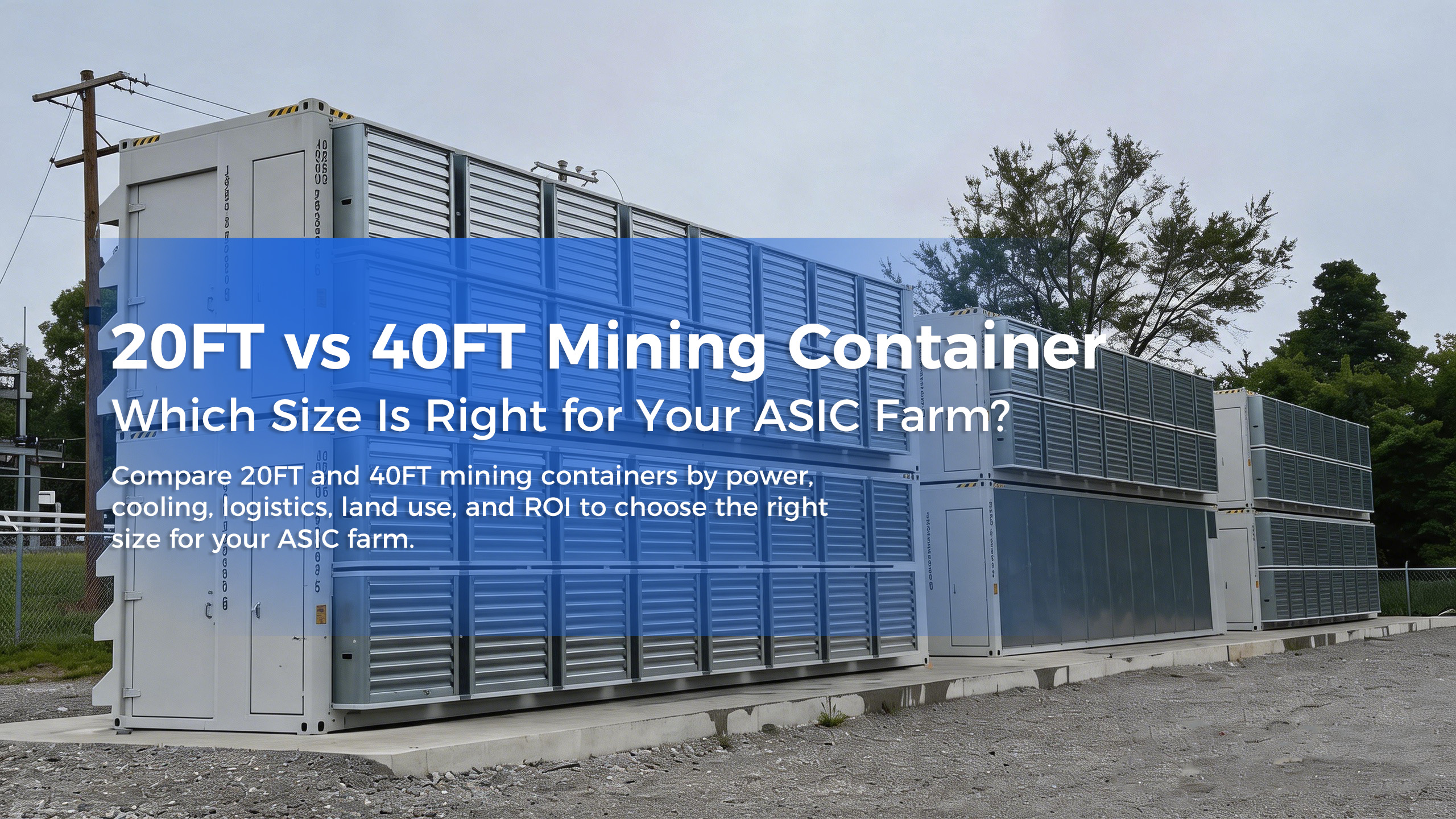
On paper, the 40FT container looks like the easy winner. Representative dry container data from DSV lists a 20FT dry container at about 5.9 m internal length and 33.2 m3 cubic capacity, while a 40FT dry container reaches about 12.03 m internal length and 67.7 m3 cubic capacity. In other words, the 40FT format gives a little more than double the internal cube. But mining containers do not earn money by cubic meters. They earn money by controlled kilowatts.
A 20FT mining container is a compact power block. A 40FT mining container is an infrastructure block. Treat them differently.
The Real Decision: Flexibility vs Cost Per Kilowatt
Go 20FT for flexibility. Go 40FT for scale.
A 20FT container is easier to position on constrained land, easier to relocate, and easier to use as a pilot module when the power supply is not yet fully proven. If your site has limited transformer capacity, uncertain grid approval, temporary gas generation, or rough access roads, a 20FT unit can reduce early-stage risk.
A 40FT container usually gives a better cost per installed kilowatt because the roof, walls, doors, control cabinet, fire system, monitoring system, and shipping process are spread across a larger mining load. If the site already has stable utility power, a prepared pad, clear crane access, and a long-term mining plan, the 40FT module is usually the more serious farm-building unit.
The trap is buying a 40FT container before the site is ready for 40FT economics. If the transformer cannot feed it, if the yard cannot ventilate it, or if the local road cannot receive it without extra handling, the extra length becomes dead capital.
Pro Tip:
If your power plan is still below one stable transformer block, start with 20FT. If your power plan is already organized into repeatable multi-hundred-kW or MW-class blocks, design around 40FT.
Space Density: More Length Does Not Automatically Mean More Hashrate
A 40FT container can hold more racks, more miners, and more electrical equipment. That part is obvious. The harder question is whether the extra length becomes usable mining density or just longer service distance.
In air-cooled designs, every additional meter affects pressure balance. Intake air must reach the miners evenly. Exhaust air must leave without recirculating into the intake side. Long rows can create weak zones if fan pressure, filter resistance, water curtain pressure drop, and miner placement are not balanced together.
This is where many low-cost containers fail. They count miner slots, not airflow paths.
For 20FT, airflow is easier to discipline. The intake-to-exhaust distance is shorter, maintenance technicians can reach every section faster, and hot spots are easier to identify. The downside is that fixed systems take up a larger share of the usable footprint. A control cabinet, walkway, fire system, and power distribution zone consume space whether the container is 20FT or 40FT.
For 40FT, the fixed systems become more efficient per miner. But the design must be more disciplined. You need proper hot/cold separation, stable negative pressure, service clearance, cable routing, and access to filters or evaporative cooling components. Data center airflow management follows the same principle: cooling efficiency depends on reducing hot air recirculation and bypass airflow, not just adding more fans.
Pro Tip:
Do not ask only “how many ASICs fit?” Ask “how many ASICs can run at target temperature after filters are dirty, ambient temperature is high, and technicians still need safe access?”
Logistics: The 20FT Container Is Agile, the 40FT Container Is Efficient
Both 20FT and 40FT containers benefit from global container standardization. ISO 668 defines series 1 freight containers by classification, dimensions, and ratings for intercontinental traffic. This matters because mining infrastructure is not just factory equipment. It is also a logistics product.
A 20FT container is easier to move through complicated inland routes. It needs less turning space, is easier to stage in a crowded yard, and can be useful when the final site is still under construction. It also gives operators the option to split deployment across several small pads instead of waiting for one large prepared area.
A 40FT container is usually more efficient for sea freight and project scaling. You move more mining capacity per shipment, per crane operation, and per electrical design package. The container itself becomes a repeatable module: same pad size, same cable trench logic, same ventilation clearance, same commissioning checklist.
The hidden cost sits in the last mile. Remote mining sites often look cheap on land cost and painful on delivery. If roads are narrow, soil is soft, cranes are limited, or local permits are slow, smaller containers can protect the schedule. If the site is industrial, flat, and accessible, the 40FT module wins.
Go 20FT for uncertain last-mile access. Go 40FT for prepared industrial deployment.
Power Distribution: Bigger Container, Bigger Fault Discipline
Mining containers are electrical rooms with miners inside.
The 40FT format makes sense when the electrical design is ready to support larger feeder capacity, higher branch circuit counts, stronger grounding, proper emergency shutdown, and a panel design that can survive real operating conditions. This is especially important for North American deployments, where buyers often ask about UL/CSA-related compliance, NRTL-listed components, field evaluation, SCCR, and local inspection acceptance.
OSHA’s NRTL program explains why certification marks matter: recognized laboratories test and certify certain products for compliance with applicable product safety standards. For a mining container buyer, this does not mean every container is automatically approved everywhere. It means the electrical package must be designed, documented, labeled, and inspected with the target jurisdiction in mind.
A 20FT container keeps electrical complexity more contained. It can work well for staged growth, testing different miner models, or serving as a dedicated unit for one power source. A 40FT container reduces duplicated electrical overhead, but failure impact is larger. If one main power cabinet or cooling loop takes down a 40FT block, more miners stop at once.
Pro Tip:
For 40FT projects, review the single-line diagram before reviewing the rendering. If the breaker coordination, grounding, emergency stop, PDU layout, and SCCR are weak, the beautiful container image is irrelevant.
Cooling Choice Changes the Size Decision
Air cooling makes container length more sensitive. Hydro cooling and immersion cooling change the equation.
For air-cooled mining containers, 20FT is easier to balance. The pressure path is shorter, filter maintenance is simpler, and the container can be placed with more flexible exhaust clearance. But if you need large-scale deployment, too many small air-cooled containers can create a messy site: more gaps, more cable runs, more intake conflicts, and more maintenance routes.
For hydro cooling, a 40FT layout can be efficient because the cooling distribution system can serve a larger number of miners inside one container. The critical question becomes CDU capacity, pump redundancy, manifold balance, and service access. A longer container is acceptable if coolant flow is uniform and the system can isolate sections for maintenance.
For immersion cooling, 40FT often becomes attractive because tanks, pumps, filters, pipework, and maintenance aisles consume meaningful space. A 20FT immersion unit can work, but the fixed mechanical system may take too much of the footprint unless the project is intentionally small or mobile.
Short version: air cooling favors simplicity; liquid systems favor planned density.
Land Use: Count Hashrate Per Prepared Square Meter
Land cost is not only the rent or purchase price. It is grading, drainage, concrete, cable trenching, transformer clearance, road access, fencing, fire separation, and maintenance circulation.
A 20FT container can fit into smaller spaces and irregular sites. That is valuable when power is scattered across multiple small sources or when a mine wants to test a new region before committing capital. But many 20FT units can waste land through repeated clearances. Every unit needs safe access, airflow clearance, cable entry, and service space.
A 40FT container usually improves hashrate per prepared square meter. It reduces repeated site work and gives the operator a cleaner farm layout. Rows of 40FT units are easier to map, monitor, and expand when the site has enough ventilation spacing.
The best operators do not maximize container count. They maximize profitable power density.
Pro Tip:
When comparing layouts, draw the site with real clearance zones. A 20FT unit that looks efficient in isolation may lose against a 40FT unit once exhaust space, cable trenches, truck access, and transformer setbacks are included.
ROI Framework: The Five Numbers That Matter
Forget the container price for a moment. Build the ROI model around five numbers.
1. Landed cost per usable kilowatt. Include container manufacturing, electrical fit-out, cooling system, sea freight, port handling, inland transport, crane unloading, permits, and site works.
2. Miner count at stable operating temperature. Do not use maximum theoretical slot count. Use the number of miners that can run through hot weather, dirty filters, normal voltage variation, and maintenance cycles.
3. Electrical overhead per miner. Compare main cabinet, PDU, cable, breaker, monitoring, emergency stop, and grounding cost per miner. Larger containers often reduce this overhead, but only if the design is clean.
4. Cooling cost per kilowatt. Fans, water curtains, dry coolers, pumps, CDU, immersion tanks, coolant, and filtration all belong in the same calculation. A cheap air design that throttles miners is not cheap.
5. Downtime exposure. A 20FT unit creates smaller failure domains. A 40FT unit can be more efficient, but a single fault can take down a larger block. This matters when replacement parts or technicians are far away.
If the 40FT container lowers landed cost per usable kilowatt and the site can support it, choose 40FT. If the 20FT container reduces deployment risk and starts revenue earlier, choose 20FT.
Final Verdict for 2026 ASIC Farm Deployment
Choose 20FT when the project is early, mobile, experimental, power-limited, land-constrained, or dependent on rough last-mile logistics. It is the better container for pilot farms, phased power buildouts, high-risk locations, and operators who value flexibility over maximum density.
Choose 40FT when the project has confirmed power, prepared land, repeatable electrical design, and a clear expansion plan. It is the better module for serious commercial farms because it usually improves cost per usable kilowatt, site organization, and operational efficiency.
The smartest strategy is often not either-or. Use 20FT for testing, edge sites, spare capacity, or special miner batches. Use 40FT as the repeating production module once the site conditions are proven.
Do not buy the biggest container. Buy the container size that turns your available power into the most reliable hashrate at the lowest delivered cost.
For most professional ASIC farms in 2026, that means this: validate with 20FT when uncertainty is high, scale with 40FT when the power block is real.