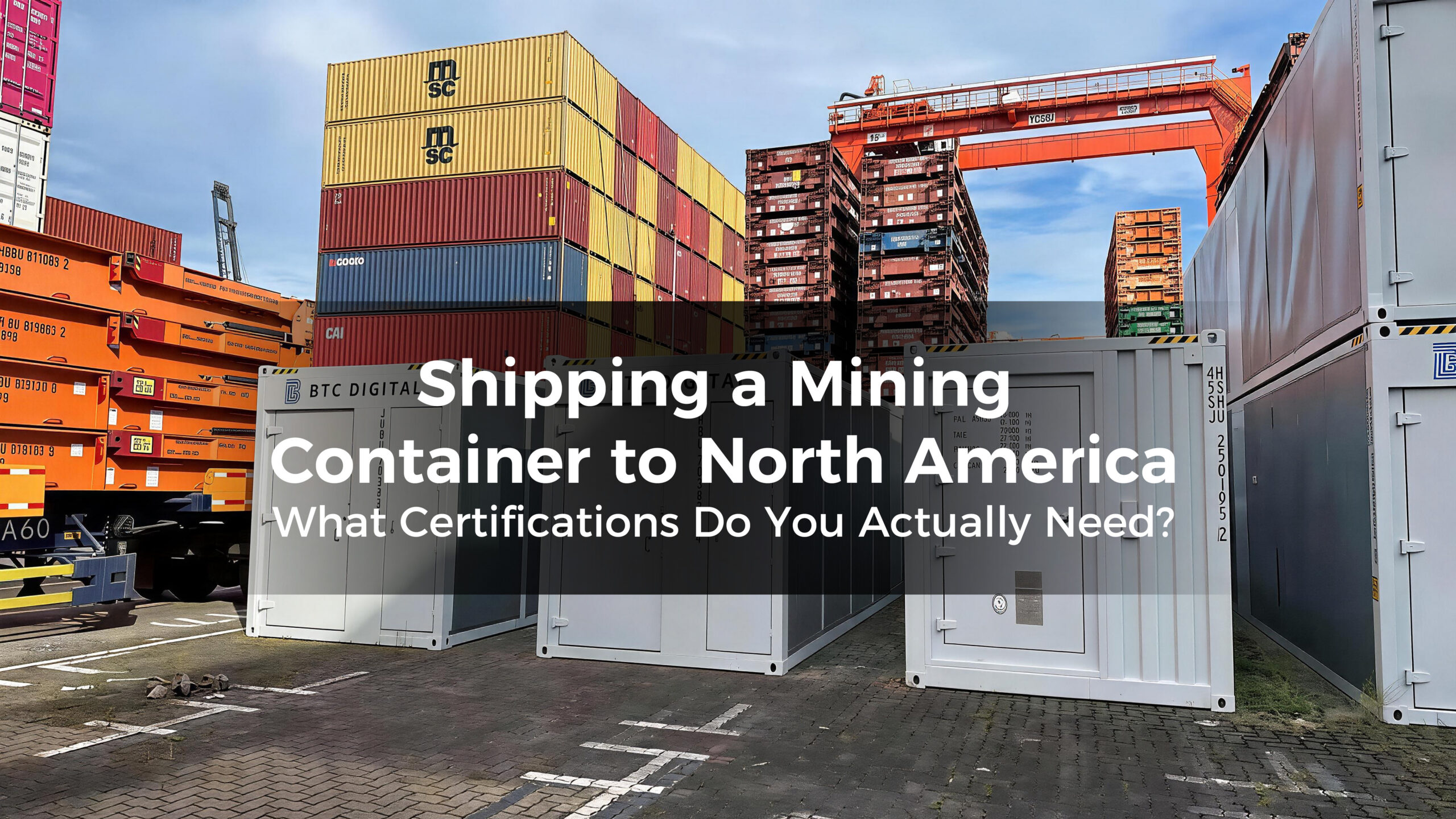
A million-dollar shipment of hashing hardware sits rotting at the Port of Houston because a customs broker flagged a missing compliance sticker. Local utility inspectors refuse to energize your site. Your insurance provider denies a catastrophic fire claim because your infrastructure lacks certified field evaluation plates.
This nightmare happens to experienced mining farm operators every single week.
Importing a mining container to North America demands more than standard logistics; it requires ironclad technical compliance. If you treat your deployment like a simple modified metal box, you risk total capital forfeiture. To protect your investment, you must treat your container as a massive, grid-tied industrial substation.
The Core Compliance Pillars: UL and CSA Certifications
Local inspectors, known as Authorities Having Jurisdiction (AHJs), hold absolute power over your deployment site. To clear customs and secure grid connection smoothly, you must source a UL mining container or a CSA certified mining container.
UL Mining Container Requirements
A true UL mining container satisfies rigorous safety metrics, ensuring that every internal component—from the 3200A intelligent power distribution units (PDUs) to the sub-8ms Static Transfer Switches (STS)—prevents catastrophic electrical failure. Do not rely on component-level certifications alone. North American inspectors demand a full system certification, such as UL 2200 or a certified Field Evaluation label, covering the entire assembled enclosure. Without this, local utilities will red-tag your site immediately.
CSA Certified Mining Container Benchmarks
For Canadian deployments and strict US jurisdictions, utilizing a CSA certified mining container remains non-negotiable. The Canadian Standards Association sets explicit benchmarks for high-voltage industrial enclosures. A CSA mark proves your infrastructure withstands extreme thermal stress and safely isolates high-voltage paths. Operating without this mark invites massive regulatory fines and guarantees insurance claim denials if an incident occurs.
Why Generic Containers Fail: The Professional Manufacturing Benchmark
Cheap, generic modified shipping containers fail North American inspections almost 100% of the time. Non-certified manufacturers frequently utilize non-listed breakers, unrated aluminum wiring, and substandard enclosures that buckle under thermal stress.
This is where professional manufacturing standards separate viable projects from bankrupt operations. High-capacity, engineered infrastructure—such as precision-built 40-foot liquid-cooled 2.5MW containers or advanced modular air-cooled enclosures—incorporates compliance directly into the blueprint. Professional manufacturing ensures:
Total segregation between high-voltage switchgear and data lines.
Factory-integrated, certified cooling circuits that eliminate condensation risks.
Full compliance with regional electrical codes before the unit ever reaches the port.
Sourcing a professionally manufactured unit eliminates the risk of local utility rejection, protecting your mining container import timeline from indefinite delays.
The Hidden Technical Killers: Load Balancing, Fire Suppression, and CSC
A successful mining container import requires satisfying critical technical demands far beyond basic wiring. You must address three specific compliance vectors before your cargo leaves the factory floor:
Electrical Load Balancing
North American grids enforce strict phase balancing and harmonic distortion mitigation. Your container must house precision-engineered electrical distribution systems. Poor load balancing triggers grid instability, damages expensive ASIC miners, and results in severe financial penalties from your utility provider.
Fire Suppression System Compliance
Local fire marshals enforce National Fire Protection Association (NFPA) standards aggressively. Your infrastructure must feature certified clean-agent fire suppression systems (such as NFPA 2001 compliant systems) tied directly to a PLC-controlled automated shutdown mechanism. If your container lacks an integrated, certified fire control path, customs officials can flag the unit as a safety hazard and deny entry.
Structural CSC Certification for Ocean Freight
Ocean carriers will reject your cargo, or customs will seize it at the terminal, if the structure lacks a valid International Convention for Safe Containers (CSC) plate. Modifying a shipping container by cutting out walls for fans or cooling vents without structural re-certification voids its CSC rating. Professional manufacturers re-test and re-certify the structural integrity of the frame, ensuring legal and safe intermodal transit.
Your Roadmap to a Successful Import
To secure your capital and accelerate your path to hashing, follow this execution strategy:
Mandate System-Level Listing: Require your manufacturer to provide factory-level UL or CSA system evaluations, not just component certificates.
Verify the CSC Status: Ensure the modified container possesses a valid, stamped CSC plate before booking ocean freight.
Secure Local Engineering Stamps: Obtain localized PE (Professional Engineer) stamps for your specific deployment state or province to streamline local AHJ approval.
Do not allow missing paperwork to jeopardize your mining infrastructure. Prioritize industrial-grade certification from day one to guarantee a profitable, compliant deployment.