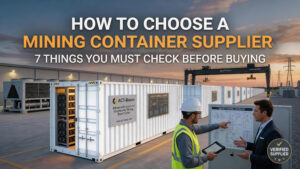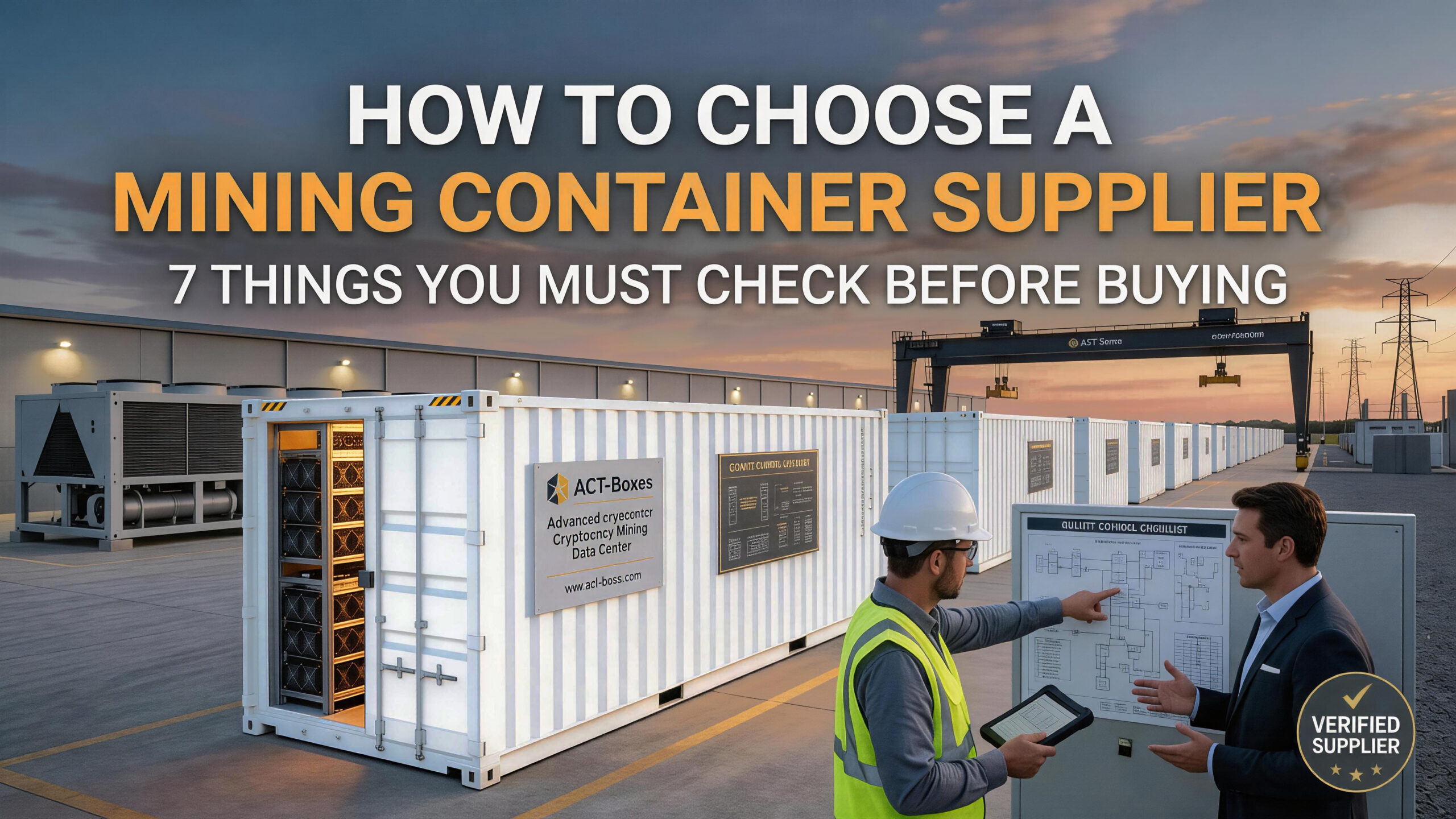
Most buyers get burned not because they chose the wrong cooling technology. They get burned because they chose the wrong supplier.
We have been manufacturing and deploying ASIC mining containers — air-cooled, liquid-cooled, and immersion — long enough to see exactly how these deals go wrong. A supplier quotes an attractive number. The buyer wires a deposit. The container arrives and nothing matches the spec sheet. The electrical certifications are missing or fake. The cooling system fails within 90 days. The supplier stops responding.
By the time you realize the problem, your capital is locked up in hardware that is either underperforming or sitting idle.
This article is the checklist we wish every buyer had before they started conversations with suppliers. Use it.
Verify They Actually Manufacture — Not Just Resell
This is the first question, and most buyers skip it entirely.
A genuine manufacturer controls the design, the materials, the production floor, and the quality inspection process. A reseller buys containers from a third-party factory, slaps a logo on them, and marks up the price. The problem is not the markup. The problem is that when something goes wrong — and something always goes wrong — the reseller has no engineering authority to fix it. They call the factory. The factory says it is not their problem. You wait.
How to Tell the Difference
Ask for a factory audit. A reputable manufacturer will readily send you photos and videos of their production floor, welding stations, and electrical assembly lines. Furthermore, you can request an in-person visit or arrange a third-party inspection before shipment. This step ensures you are working with a genuine partner who maintains high production standards.
Ask who designed the cooling system. A genuine manufacturer should be able to clearly name the engineers responsible and explain the thermodynamic reasoning behind their design choices — including airflow path, pipe sizing, and heat exchanger surface area. In contrast, a reseller usually cannot answer this question with credibility.
Ask how long they have been manufacturing this specific product. Generic container fabricators who pivoted to mining boxes during the last bull run are not the same as companies with years of purpose-built mining infrastructure experience.
Our team has participated in the construction and commissioning of multiple large-scale liquid cooling mining container deployments. Moreover, we have run our own mining farms. This hands-on experience enables us to collect real operational data and feed it back into product development. Ultimately, this closed feedback loop is what separates a serious manufacturer from a fabricator merely chasing a trend.
Demand Real Certification Documentation — Not Just Logos on a Brochure
Certifications are not mere decoration. In fact, they are critical legal requirements in most commercial deployment scenarios. Moreover, they often determine the difference between a container that your insurance company will cover and one that it will not.
What Certifications Actually Matter
For electrical systems deployed in North America, you need UL or CUL listed mining hardware. UL covers the United States. CUL covers Canada. Both certifications mean an independent testing laboratory has verified that the electrical components meet the relevant safety standards. Without them, you face potential liability exposure on every machine running in that container.
For European deployments, CE marking on electrical assemblies is the baseline requirement.
If a supplier shows you a brochure with UL and CE logos but cannot produce the actual test reports and certificate numbers, treat those logos as meaningless. Ask for the certificate serial number. Verify it independently on the certification body’s public database.
We hold CE and UL certifications on our power distribution systems and electrical assemblies. Our air-cooled units carry CUL certification. These are documented, verifiable, and current. Any supplier who cannot match this standard on paper should not be on your shortlist.
Container Structural Certification
Beyond electrical, verify that the container body itself meets international transport and stacking standards. A mining container travels by ship, rail, and flatbed truck before it reaches your site. It needs to withstand the mechanical loads of standard container handling — corner casting strength, stacking load ratings, forklift pocket integrity.
Ask for the structural certification from a recognized classification society. This matters especially if you plan to stack containers vertically to maximize site density.
Evaluate the Thermal Engineering — Not Just the Cooling Type
Most supplier conversations about cooling stay at the surface level. Air cooling, liquid cooling, immersion. That is not enough information to evaluate a product. The real question is how well the cooling system is engineered within each category.
Air Cooling: What to Look For
A well-designed air cooled mining container does more than blow air through a box. It manages airflow path, intake filtration, humidity buffering, and heat stratification inside the enclosure. The dual water curtain design — an outer layer to drop ambient temperature and an inner layer to buffer humidity before it reaches the machines — is an example of purpose-built thermal engineering, not just component assembly.
Ask for the maximum supported ambient temperature. Ask how the system behaves when ambient exceeds that limit. A supplier who cannot describe the thermal de-rating curve of their container at high ambient temperatures does not understand their own product.
Liquid Cooling: The Numbers That Matter
For a liquid cooling mining container, the critical specifications are not just cooling capacity in kilowatts. They are the heat transfer coefficient of the fluid path, the hydraulic balance of the distribution manifold, and the material specification of every wetted component.
Water has a specific heat capacity of 4.187 kJ per kilogram per Kelvin. This is more than twice the value of dielectric oil used in immersion systems. That gap directly affects pump sizing, flow rate requirements, and the efficiency of your external heat rejection system — the dry cooler.
The manifold design matters enormously. Every miner slot should see identical hydraulic resistance from the main supply to its connection point. If your manifold is not balanced, some machines run hot and some run cold. Hot machines throttle or fail. Cold machines waste cooling capacity. Neither outcome is acceptable at scale.
Our ACT-2C40 closed-loop liquid cooling system uses a full 304 stainless steel circuit with a hydraulically balanced distribution design. Every slot has the same pipe length and the same flow resistance. Each connection point uses a stainless micro ball valve and a dry-disconnect quick coupling, so individual miner removal never requires a system shutdown.
Mining Container PUE Efficiency — The Number That Determines Your Long-Term Profitability
PUE, or Power Usage Effectiveness, is the ratio of total facility power to IT load power. A PUE of 1.0 represents theoretical perfection, where every watt goes directly to mining.
However, traditional mining farms with inadequate cooling routinely operate at a PUE between 1.3 and 1.5. This means 30 to 50 percent of your electricity spend is wasted and not producing any hash rate. For example, on a deployment running 2,400 kilowatts of load, the cost difference between a PUE of 1.4 and 1.05 is enormous. At just five cents per kilowatt-hour, this gap costs you over five hundred thousand dollars per year.
Therefore, you should ask every supplier for their documented PUE figures. Moreover, always inquire under what specific conditions those figures were measured — including ambient temperature, load percentage, and coolant flow rate. A PUE claim without clear test conditions is not a real PUE claim. In reality, it is simply marketing.
In contrast, our ACT-2C40 operates at a PUE below 1.05 under standard test conditions at 30 degrees Celsius ambient. Importantly, this figure comes from real operational data, not simulations.
Inspect the Power Distribution System in Detail
The power distribution system is not a commodity component. It is the nervous system of your mining container, and failures here cause more downtime than any other single factor.
What a Serious PDU Looks Like
A purpose-built power distribution unit for ASIC mining should include individual circuit protection for every miner slot. Not group breakers. Individual breakers. When one machine trips, only that machine goes offline. Everything else keeps running.
Smart PDU monitoring — per-outlet current sensing, remote switching capability, and over-threshold automatic shutdown — is the feature that reduces the human labor cost of running a large mining installation. Without it, you need people physically walking the facility to identify which machine is drawing anomalous current.
Surge protection devices should be present on the main incoming supply. This is basic electrical engineering practice that some cost-cutting manufacturers skip entirely.
For our liquid cooling installations, the 3200A intelligent power distribution cabinet handles up to 2,257 kilowatts of managed load capacity. It accepts three-phase input across 350 to 415 volts at both 50 and 60 hertz — which matters when you are deploying a 40ft mining container for sale into markets with different grid standards. Individual breakers cover every miner slot. An energy meter with data logging is integrated. The whole assembly carries CE and UL certification.
Input Voltage Flexibility
Your mining site may not have the same grid voltage as your supplier’s home market. Ask explicitly what input voltage range the container supports. A supplier who only tests and certifies at one voltage level is a supplier who has not designed for real-world deployment diversity.
Understand the Deployment Process Before You Sign Anything
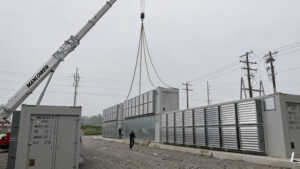
How to deploy a mining farm with containers sounds straightforward until you are on-site with a crane and a container that requires specialized commissioning steps your supplier never mentioned.
What Plug-and-Play Actually Means
There is a spectrum between “fully self-contained and operational in hours” and “requires a specialist team for multi-week commissioning.” Know where your supplier’s product sits on that spectrum before you commit.
A well-engineered liquid cooling container should require only the connection of standardized flanged pipe joints between the miner container and the external heat rejection unit, plus the main power connection. If it requires more than that to achieve operational status, that complexity carries real cost — specialist labor, commissioning time, and the risk that something is configured incorrectly.
Our ACT-2C40 bitcoin mining container setup process is: position the dry cooler container, connect four flanged pipe joints, connect main power. The PLC control system handles sequencing, temperature regulation, and protection functions automatically. A ten-inch touchscreen HMI provides full visibility from day one.
Ask About Pre-Commissioning Factory Testing
A serious manufacturer runs the complete system — cooling circuit pressurized, electrical systems energized, control logic active — before the container leaves the factory. Ask for factory acceptance test documentation. Ask what parameters were verified and what the pass criteria were. If a supplier cannot show you factory test records, your site is effectively their test bench.
Evaluate Their After-Sales Support With the Same Rigor as the Hardware
The container is not the product. The container plus the support relationship is the product.
What Good After-Sales Support Looks Like
A supplier who has operated mining farms at scale — not just manufactured equipment for others — understands problems you cannot fully anticipate at the design stage. Coolant chemistry interactions with specific pipe materials. How PLC control logic behaves when ambient temperature drops below the heating threshold. Why a particular miner model draws anomalous current at startup and what that means for breaker sizing.
This operational knowledge only comes from running the equipment yourself. Ask your supplier whether they operate their own mining facilities. Ask what problems they have encountered and how they resolved them.
Remote Monitoring Capability
Your support team cannot fly to your site every time an alarm triggers. Ask whether the container’s control system supports remote monitoring and remote parameter adjustment. Ask what data the system logs, how long it retains that data, and whether it can integrate with your existing fleet management tools.
Our control systems log historical performance curves, operational events, and alarm history. Temperature setpoints, pressure thresholds, and pump operating modes are all adjustable remotely without requiring physical access to the container. When an issue occurs at three in the morning on a site with minimal on-site staffing, that capability is not a nice-to-have. It is operationally essential.
Spare Parts Availability
Ask which components are likely to require replacement within the first two years of operation and whether those parts are stocked. Ask what the lead time is for a replacement circulation pump, a fan module, or a control board. A supplier whose spare parts lead time is twelve weeks has effectively built a twelve-week downtime risk into your operation every time a critical component fails.
Compare CAPEX and OPEX Together — Never Evaluate Price in Isolation
The cheapest container on the quotation sheet is almost never the cheapest container over an eighteen-month operating cycle.
How to Build an Honest Cost Comparison
Take the quoted container price and add the estimated installation cost. Then factor in twelve to eighteen months of electricity expenses, calculated at your specific site rate using the supplier’s documented PUE as the multiplier. Next, include estimated maintenance labor costs, along with any certification or compliance work required for your deployment jurisdiction. This total represents your real cost of ownership.
A container running at PUE 1.35 costs dramatically more to operate than a container running at PUE 1.05 — even if the purchase price is significantly lower. At a 2,400 kilowatt load and five cents per kilowatt-hour, the annual electricity cost difference between those two PUE figures exceeds six hundred thousand dollars. The capital cost difference between an air cooled mining container and a liquid cooling mining container rarely approaches that figure.
Mining Container vs. Traditional Mining Farm — The Comparison That Often Gets Skipped
A traditional mining farm requires permanent facility construction, fixed cooling infrastructure, and a long-term site commitment. The capital is largely non-recoverable if site economics change. A containerized system is modular and relocatable. If power costs rise at your current site, you move. That optionality has real financial value that most buyers never account for in their initial analysis.
The mobile bitcoin mining container format specifically targets this flexibility advantage. If your operation needs to follow low-cost power — stranded energy, curtailment agreements, seasonal hydroelectric — a container-based deployment is structurally better suited to that business model than any fixed facility.
The Question Every Supplier Should Be Able to Answer
Before you finalize any supplier relationship, ask this: “Can you walk me through a deployment you have done at a similar scale to what I am planning, including what went wrong and how you resolved it?”
A confident, specific, technically detailed answer to that question tells you more about supplier quality than any certification document or specification sheet.
A vague answer, an answer that redirects to marketing materials, or a supplier who has never operated at the scale you are targeting — those are your signals to keep looking.
We have built and operated large-scale mining installations, where we encountered the unique challenges that only emerge at scale. As a result, we engineered practical solutions directly into our products. This hands-on experience forms the foundation of a supplier relationship truly worth entering.
When you are ready to evaluate a 40ft mining container for sale, or discuss a full ASIC miner wholesale supplier arrangement for your operation, our team is available for a direct technical conversation. No sales pitch. Just engineering.
Visit blockchain-miner.com to start that conversation.