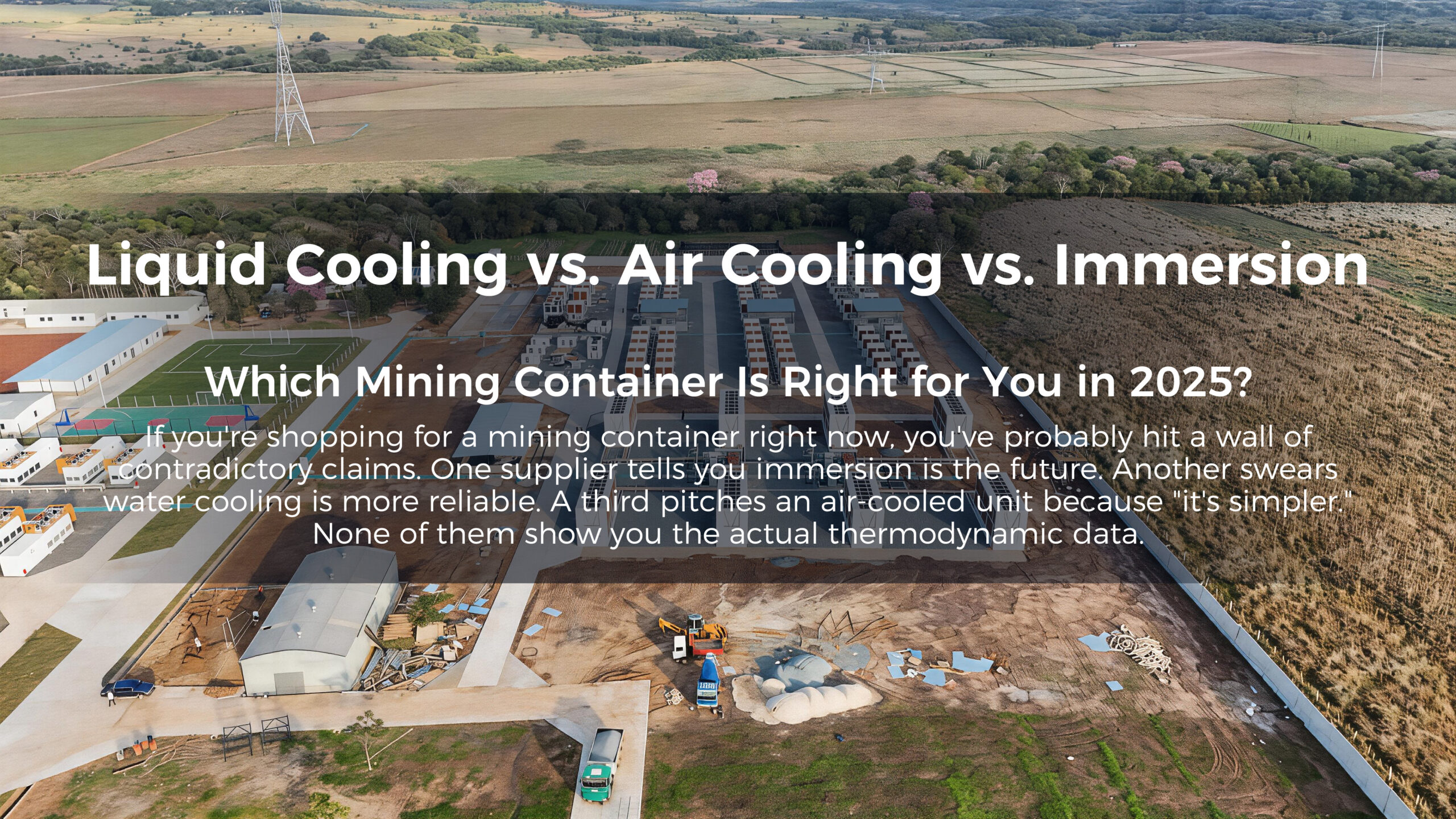
If you’re shopping for a mining container right now, you’ve probably hit a wall of contradictory claims. One supplier tells you immersion is the future. Another swears water cooling is more reliable. A third pitches an air-cooled unit because “it’s simpler.” None of them show you the actual thermodynamic data.
We will.
At Blockchain-Miner.com, we manufacture and deploy all three types. We run our own mining farms, which means we see the real performance numbers — not just spec sheets. This is the comparison we wish someone had written for us before we built our first large-scale installation.
First, Understand What You’re Actually Buying
A mining container is not just a box with fans. It’s a thermal management system that happens to hold ASIC miners. Every design decision — from pipe diameter to fan blade pitch — affects your PUE, your uptime, and ultimately your profitability.
Mining container PUE efficiency is the single most important operational metric. PUE stands for Power Usage Effectiveness. A PUE of 1.0 is theoretically perfect — every watt goes to mining. Traditional mining farms routinely hit PUE of 1.4 or worse. Our liquid-cooled ACT-2C40 40ft mining container runs at PUE < 1.05. The math on that difference, across a 2.4 MW installation, is brutal.
Let’s go through each cooling approach honestly.
Air Cooling — The Low Barrier Entry Point
How It Works
Air-cooled mining containers use a combination of high-volume fans and, in better-designed units, a dual-layer evaporative water curtain system. The outer curtain drops the internal ambient temperature; the inner curtain buffers humidity before it reaches your machines. The miners’ own fans handle the rest.
This is exactly the design philosophy behind the Module Box air-cooled units — purpose-built for large-scale digital mining with a realistic operating range of -35°C to 50°C ambient. That kind of thermal tolerance matters if your site is in Texas in July or Alberta in January.
The Real CAPEX Advantage
Air cooling wins on entry cost. Full stop. The reason for this is that the hardware is much simpler, and consequently, the installation is faster. In addition, you don’t need a specialized water treatment system or a separate dry cooler container. Therefore, for operators testing a new site or scaling from 0 to 420 miners without locking in huge capital, the 40HC air-cooled format remains a serious option.
A 40ft air-cooled mobile bitcoin mining container typically supports around 420 machines at up to 1,500 kW total load, with CE/CUL certified electrical systems. You can have it on-site and operational in days, not weeks.
Where Air Cooling Breaks Down
At scale, the economics shift. Once ambient temperatures climb above 35°C, you’re running water curtains continuously. Cooling efficiency drops. Your PUE creeps up. Miners throttle or shut down. If your site doesn’t have reliable water access or your ambient temperature swings wildly, air cooling becomes a maintenance story, not a cost story.
There’s also the density ceiling. Air-cooled containers max out at what the miners’ own fans can handle. You’re constrained. You cannot push next-generation ASIC hardware — machines pulling 6kW+ per unit — into an air-cooled setup and expect stable uptime.
Air cooling is best for: Operators who need rapid deployment, geographic flexibility, or are running standard-generation hardware (S19 Pro class) at moderate ambient temperatures. The mobile bitcoin mining container format excels here.
Liquid Cooling — The Engineering Workhorse
The Physics Behind the Performance
Water has a specific heat capacity of 4.187 kJ/(kg·K). Cooling oil — used in immersion systems — sits at roughly 2 kJ/(kg·K). That’s not a minor difference. As a result, water moves more than twice the heat per unit of mass flow. This efficiency allows the pump to work significantly less, while the dry cooler operates at peak efficiency. Ultimately, your entire system achieves far higher performance with less energy input.
The heat transfer coefficient for water is 700–1,000 W/(m²·°C). For immersion cooling oil, it’s 400–500 W/(m²·°C). For an engineer, that gap is significant. To achieve the same heat rejection in an immersion system, you need a dry cooler that is 2 to 2.5 times larger than a water-cooled equivalent.
Our ACT-2C40 liquid cooling mining container is built around a fully closed-loop circuit. Because the coolant never contacts the atmosphere, operators experience zero evaporation loss and complete protection against external contamination. Furthermore, this design eliminates the mineral buildup typically associated with open cooling towers. After the initial fill, the system runs in slight positive pressure and maintains water quality indefinitely — as long as you use the correct inhibitor mix.
The ACT-2C40 — What 2,400 kW of Closed-Loop Cooling Looks Like
The ACT-2C40 is a dual 40HQ container system. One container houses the miners; the other is the dry cooler. At 30°C ambient, the system delivers 2,400 kW of cooling capacity. It handles up to 392 units of the Antminer S19/S21 Hydro — the hydro miner container format designed specifically for this class of machine.
The dry cooler container uses 20 high-airflow AC fans across 8,606 m² of heat exchange surface area. Inlet water temperature: 40°C. Outlet: 50°C. Maximum airflow: 333,529 CFM. Noise at 10 meters: ≤75 dB. These aren’t estimates — they’re tested figures from real deployments.
The plumbing is all 304 stainless steel, running a balanced hydraulic circuit so every miner slot sees identical flow resistance. Each slot gets its own stainless micro ball valve and quick-connect fitting. Hot-swap maintenance without system shutdown. That matters when you’re managing 392 machines.
Deployment — Simpler Than You’d Think
This is where the liquid cooling container surprises most people. In fact, the bitcoin mining container setup process for the ACT-2C40 is remarkably straightforward. To begin with, you simply place the dry cooler container, and then connect four flanged pipe joints. Once these are secure, you just connect the main power. That’s absolutely it. Meanwhile, the integrated PLC control cabinet handles everything else behind the scenes — including automated pump sequencing, precise temperature control, pressure management, and advanced fault detection.
The 10-inch HMI touchscreen gives you real-time control over supply/return water temperatures, pressure differentials, and circuit flow. Historical performance curves, alarm logs, and operation journals are all logged automatically. If something is wrong at 3 AM, you know before it becomes a problem.
On weight and logistics: the miner container ships at 9,080 kg, the dry cooler at 9,230 kg. Standard flatbed transport. Water system volume is 2,000 liters per circuit. When you’re planning how to deploy a mining farm with containers, this modularity is a genuine operational advantage — you scale in discrete, self-contained units.
CAPEX vs. OPEX — The Honest Calculation
Liquid cooling costs more upfront than air cooling. The closed-loop plumbing, stainless manifolds, PLC integration, and dry cooler infrastructure carry a real price premium. Don’t let anyone tell you otherwise. However, once you run the 18-month OPEX calculation, the financial picture changes completely.
First and foremost, the primary advantage lies in the efficiency gap, with the ACT-2C40 delivering a PUE of < 1.05 compared to the industry average of 1.25–1.40 for air-cooled or poorly designed systems. At a 2,412 kW load, therefore, this PUE discrepancy translates to 480–840 kW of wasted power in a competing system — every single hour. Assuming a standard rate of $0.05/kWh, that waste equates to $24–$42 per hour, or $576–$1,008 per day. Over an 18-month operational horizon, this results in an astonishing $310,000–$544,000 in avoidable electricity costs.
In addition to power savings, ongoing maintenance expenses are significantly reduced. Specifically, the closed-loop system eliminates water treatment complexity, scale buildup, and the frequent fan replacement cycles driven by external contamination. Furthermore, this controlled environment directly protects the miner’s residual value. Because water-cooled Hydro miners run in a clean, temperature-regulated circuit, they consistently retain higher resale value and perform like new when it comes time to upgrade.
To support this massive throughput, the 3200A intelligent PDU that ships with the ACT-2C40 handles up to 2,257 kW of managed power capacity. This industrial-grade distribution infrastructure features individual breakers per miner, integrated SPD protection, and full CE/UL certification — consequently making it fully compliant with North American electrical codes and ready for CSA certified container deployments.
In conclusion, liquid cooling is best for operators running S19/S21 Hydro class machines or above, deploying at scale (200+ units), targeting sites where electricity cost is a primary concern, and building for the long term.
Immersion Cooling — The Hype vs. The Reality
The Appeal
Immersion cooling is technically elegant. Specifically, you drop the miners into dielectric fluid, where the fluid absorbs heat directly from the chips, and a heat exchanger moves that heat outside. Because of this fluid-driven design, there is absolutely no need for server fans, which consequently makes the operation extremely quiet. Furthermore, this approach eliminates airflow bottlenecks, thereby enabling an exceptionally high thermal density per square meter.
For ultra-high-power machines — hardware pulling 5kW to 10kW+ — immersion cooling becomes genuinely relevant because you can’t air-cool those power densities safely. The immersion mobile mining container format can pack 384 units into a single 40ft footprint at up to 1.8 MW, with per-slot maximum loads of 6 kW. That density is real and impressive.
The Problems Nobody Talks About
Let’s look at the physics again. Cooling oil’s specific heat is 2 kJ/(kg·K) — which is exactly half of water. Consequently, to achieve the same heat transfer rate, your pump needs to move twice the volume of fluid. This requirement inevitably leads to larger pumps, higher energy consumption, and ultimately, a significantly increased parasitic load on your entire mining infrastructure.
The heat transfer coefficient of 400–500 W/(m²·°C) means your external heat exchanger needs to be 2 to 2.5 times larger than a water-cooled equivalent for the same heat rejection duty. That’s more capital, more space, more complexity.
Then there’s the material compatibility issue. Most fluid-handling components in the industry — pumps, valves, seals, fittings — are designed for water, not dielectric oil. If you want proper long-term seal integrity with cooling oil, you’re sourcing custom components or paying a premium for compatible ones. The alternative is dealing with slow leaks that contaminate your facility and your machines.
Cable systems are another hidden cost. Standard waterproof connectors and cables handle water-cooled environments fine. Immersion oil requires oil-resistant connectors and jacketing. At scale, that adds up.
And then there’s fire safety. A closed-loop water system has minimal fire risk. Immersion tanks are semi-sealed — low-flashpoint oil vapors continuously off-gas at operating temperatures. Proper fire suppression is not optional; it’s a significant infrastructure line item.
Finally: miner residual value. A machine that’s spent two years soaking in dielectric fluid is harder to resell. The oil penetrates everything. Secondary market buyers discount heavily for this.
Immersion cooling is best for: Operators running bleeding-edge hardware above 5kW per machine, prioritizing noise reduction in inhabited areas, and with the budget and technical infrastructure to manage the complexity properly.
Head-to-Head — The Decision Matrix
| Factor | Air Cooling | Liquid Cooling (ACT-2C40) | Immersion |
|---|---|---|---|
| CAPEX | Low | Medium-High | High |
| PUE | 1.20-1.40 | < 1.05 | 1.05-1.15 |
| Deployment Speed | Fast | Medium | Slow |
| Max Load / Container | ~1,500 kW | 2412 kW | 1800 kW |
| Miner Compatibility | Air-cooled ASICs | S19/S21 Hydro + | All types |
| Maintenance Complexity | Low | Low-Medium | High |
| Miner Resale Value | Good | Excellent | Poor |
| Noise Level | High | ≤75 dB @ 10m | Very Low |
| North America Compliance | CE/CUL | CE/UL | Varies |
| Scale Suitability | Small-Medium | Large | Medium-Large |
| 18-Month OPEX | High | Lowest | Medium-High |
So What’s Right for Your Mining Farm?
Here’s the honest answer: there is no universal winner. But there is a right answer for your specific situation.
If you’re a first-time operator or testing a new power site, start with an air-cooled mobile bitcoin mining container. Low risk, fast deployment, easy to relocate if the site economics don’t work out.
If you’re running Antminer S19 Hydro, S21 Hydro, or planning to, and you want to deploy 200+ machines with long-term profitability as the goal — liquid cooling is the correct engineering decision. The ACT-2C40 was designed for exactly this use case. The OPEX savings are not marginal; they’re hundreds of thousands of dollars over an 18-month cycle.
If you’re running experimental hardware above 5kW per unit, you’re doing a boutique operation with noise constraints, or you have the technical team to manage fluid chemistry — immersion has its place.
What we don’t recommend: mixing cooling philosophies in a single deployment without proper segregation. We’ve seen it. The operational complexity destroys any theoretical efficiency gain.
A Note on Certifications — Especially for North America
If you’re deploying a mining container in North America, certification is not a checkbox. It’s a legal requirement and an insurance condition.
Our containers carry CE and UL certifications on electrical components. The ACT-2C40 system’s 3200A PDC is built to CE/UL standards, with SPD protection and integrated wiring that meets North American electrical code. Our air-cooled units carry CUL certification as well — the Canadian equivalent of UL that satisfies both US and Canadian deployment requirements.
When you’re evaluating any 40ft mining container for sale and the supplier can’t produce a CSA certified mining container report or UL listed mining hardware documentation, walk away. The liability exposure from non-certified equipment in a commercial deployment is not worth any price discount.
Ready to Figure Out Your Setup?
Talk to us before you commit capital. We’ve deployed mining containers across multiple continents, and the honest advice we give clients before they buy has saved them from expensive mistakes.
Visit blockchain-miner.com or contact our team directly. We’ll match your hardware, site conditions, and budget to the right container — whether that’s air-cooled simplicity, liquid-cooled efficiency, or an immersion system for specialized hardware.
The ASIC miner wholesale supplier relationship you want is one where your supplier has actually operated what they’re selling. We have.