Bitcoin continues its correction in February 2026, trading in the mid-$60,000s to low-$70,000s as of February 11, with intraday lows dipping near $66,500 amid ongoing market deleveraging and profit-taking. This pullback from late-2025 highs above $126,000 has triggered widespread pressure across the ecosystem, yet it mirrors classic cycle patterns where sharp dips open exceptional buying windows. Experienced miners act decisively: they scoop up discounted ASIC miners and integrate them into flexible mobile mining containers, locking in low acquisition costs to maximize mining ROI when prices recover.
Cycles Repeat: The Proven Buy-Low Strategy
History provides clear lessons for navigating these phases. Miners who accumulated during the 2018 bear market or the 2022 crash near $16,000 saw massive gains as Bitcoin surged in subsequent bull runs. Today’s environment echoes those moments—Bitcoin’s retreat has pushed hashprice to record lows around $28–$35 per PH/s, forcing weaker operators offline while manufacturers slash ASIC prices to stimulate demand. Operators respond by upgrading to next-generation models with efficiency ratings under 20 J/TH, which shorten payback periods dramatically and position fleets for stronger margins once difficulty stabilizes and prices rebound.
Hardware Discounts Fuel Expansion Opportunities
The current low hashprice environment creates one of the most attractive buying periods in recent years. Suppliers offer steep reductions on high-performance ASIC miners as inventory accumulates and revenue per unit of hashrate plummets. Miners capitalize by refreshing or expanding operations, focusing on rigs that deliver superior energy efficiency. These upgrades not only reduce operational costs but also ensure competitiveness in a network where every watt counts. Forward-thinking players pair these discounted units with robust infrastructure to handle dense deployments without excessive downtime or maintenance burdens.
Mobile Mining Containers Deliver Unmatched Agility
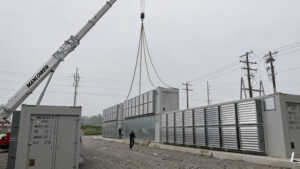
To fully leverage these hardware deals, many miners turn to mobile mining containers for superior flexibility and efficiency. These modular units—typically in 20ft or 40ft configurations—support substantial loads up to 1800kW and accommodate 144–336 ASIC miners. Features include advanced water-curtain cooling, micron-level filtration for dust protection, redundant PDUs for reliability, and CSA/UL certification that meets North American standards. Operators deploy them rapidly across regions, chasing low-cost or renewable energy sources while minimizing setup time—often launching full farms in mere hours. Blockchain-miner.com specializes in these customizable mobile mining containers, enabling up to 22% savings through optimized power distribution and reduced overhead, directly boosting mining ROI during volatile periods.
February 2026 Events Signal a Major Reset
The sector just experienced one of its most significant adjustments: Bitcoin mining difficulty dropped 11.16% to 125.86 T in early February—the largest decline since the 2021 China ban—after winter storms and price weakness knocked substantial hashrate offline. This reset eases immediate pressure on surviving miners by increasing rewards per unit of power. Meanwhile, Morgan Stanley initiated coverage on key players like Cipher Mining and TeraWulf on February 9–10, assigning positive ratings as they pivot toward AI and data center infrastructure, highlighting diversification as a hedge against pure crypto volatility.
Positioning for the Inevitable Upturn
Bitcoin’s current levels represent a textbook accumulation zone. Miners who secure ASIC miners and modular mining containers at today’s favorable terms build resilient operations that thrive on recovery. The combination of discounted hardware and portable, efficient infrastructure turns market weakness into a strategic advantage, allowing quick relocation to optimal energy zones and sustained profitability through cycles.
Act on the February Opportunity
With Bitcoin hovering around $67,000–$69,000 on February 11, 2026, the window remains open. History consistently rewards those who prepare during lows—buy low now, and position to mine high later.