The expensive mistake is not buying a CDU that is obviously too small. The expensive mistake is buying a CDU that looks large enough on a datasheet, then discovering on site that it cannot hold the required flow rate, pressure, water temperature, or redundancy when every ASIC is running at full load.
For liquid cooling mining containers, the CDU is not just a cooling accessory. It is the traffic controller between ASIC heat, coolant flow, pump pressure, heat exchanger capacity, and the outside heat rejection system. If the CDU is undersized, miners throttle. If it is poorly matched, pump energy rises, temperature stability drops, and maintenance becomes a weekly problem.
Go beyond kW. Size the system.
The CDU Is Not the Whole Cooling System
A coolant distribution unit does not destroy heat. It moves heat from the miner-side loop to the facility-side loop through pumps, heat exchangers, valves, filters, sensors, and controls.
That means a 1.3MW liquid cooling container does not only need a “1.3MW CDU.” It needs:
- Enough coolant flow on the ASIC side
- Enough pump head to overcome piping and manifold resistance
- Enough heat exchanger capacity at the chosen temperature difference
- A dry cooler, cooling tower, or chiller that can reject the same heat outdoors
- Controls that keep supply temperature stable under changing miner load
- Redundancy that matches the business cost of downtime
A CDU quote without flow rate, delta-T, pump curve, and heat rejection conditions is not a technical quote. It is a placeholder.
Start With Real Heat Load
For ASIC mining, almost all electrical power consumed by the miners becomes heat. So the first sizing step is simple:
Total heat load = miner power x miner quantity + auxiliary allowance
If a container runs 240 hydro ASIC miners at 5.5kW each, the miner heat load is:
240 x 5.5kW = 1,320kW
Then add a practical allowance for pumps, controls, power distribution loss, and future derating. For early budgeting, many buyers model a 3%-8% margin, then confirm the final number with the actual miner model, CDU supplier, piping layout, and site climate.
Do not size the CDU from average load if your revenue model depends on full-load operation. In mining, the worst hour matters because the worst hour is when ASICs throttle, reject work, or shut down.
Pro Tip: If your electrical design is based on 1.3MW but your CDU planning quietly assumes 1.1MW, the container will fail at the exact moment you need uptime most.
Flow Rate Is Where Weak Designs Show Up
Heat load tells you how much heat must be removed. Flow rate tells you whether the coolant can actually carry it.
The basic heat transfer relationship is:
Q = m x Cp x delta-T
In practical water-loop planning:
Flow rate increases when heat load rises.
Flow rate increases when allowed delta-T gets smaller.
For water, a useful planning shortcut is:
kW = 0.0697 x LPM x delta-T C
So for a 1,320kW container:
At 10 C delta-T:
LPM = 1,320 / (0.0697 x 10) = about 1,890 LPM
At 6 C delta-T:
LPM = 1,320 / (0.0697 x 6) = about 3,156 LPM
Same miners. Same heat load. Much higher flow requirement.
That is why “CDU capacity” alone is not enough. A CDU may carry the rated kW only under a specific flow rate, inlet temperature, glycol percentage, and pressure drop. Change any one of those, and the real capacity changes.
Delta-T Is a Business Decision
A wider delta-T reduces flow demand, which can reduce pump energy and pipe size. But it also means the coolant returning from the ASIC loop is hotter, and the thermal margin at the miner may shrink if the loop is not balanced.
A narrow delta-T can keep temperature more uniform, but it requires more flow. More flow can mean larger pumps, higher pressure drop, more noise, more energy use, and more stress on fittings.
For liquid cooling mining containers, the right delta-T is not chosen by habit. It depends on:
- Miner cooling plate requirements
- Manifold design
- Hose length and pipe diameter
- Glycol percentage
- Outdoor ambient temperature
- Dry cooler approach temperature
- Whether the container is deployed in Texas, North Dakota, Canada, or the Middle East
Pro Tip: Ask your supplier to show the CDU selection at two operating points: normal summer operation and high-temperature derating operation. If the design only works on a mild-weather spreadsheet, it is not ready for a mining site.
Pump Head Matters as Much as Flow
A CDU can have enough theoretical flow and still fail in the field if the pump cannot overcome system resistance.
Pressure drop comes from:
- Long pipe runs
- Small-diameter hoses
- Quick connectors
- Filters
- Valves
- Manifolds
- Cooling plates
- Elevation changes
- Glycol viscosity
- Dirty strainers over time
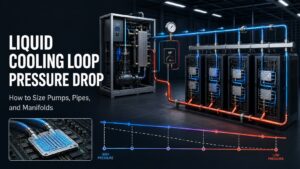
This is where many container projects get uncomfortable. The equipment arrives, miners are connected, the pump runs, and the farthest rack receives less flow than the first rack. The closest miners stay stable. The farthest miners run hotter. The operator blames the ASICs, but the real problem is hydraulic balance.
Good CDU sizing should include pump curves, expected pressure drop, balancing valves, pressure sensors, and a commissioning procedure. The container should be tested as a system, not just assembled as parts.
Redundancy: N, N+1, or Split Loops?
Redundancy is not a luxury question. It is an ROI question.
For a low-cost test site, a single CDU with dual pumps may be acceptable. In high-density containers running 24/7, an N+1 pump arrangement is usually the minimum for serious deployments. For multi-megawatt sites, splitting the load across two loops or two CDU trains significantly reduces the risk of a single failure taking down the entire container.
Here is the practical logic:
N design: lowest upfront cost, highest downtime exposure.
N+1 pump design: better protection against pump failure.
Dual-loop design: better isolation for maintenance and partial operation.
2N design: strongest uptime posture, but often too expensive unless uptime contracts justify it.
Do not buy redundancy just because it sounds professional. Buy the level of redundancy that matches the value of the hashrate you are protecting.
Pro Tip: For a container above 1MW, avoid putting the entire operation behind one single point of coolant failure. Even if you do not choose full 2N, split the hydraulic risk where possible.
Do Not Forget the Dry Cooler
The CDU transfers heat. The dry cooler, cooling tower, or chiller rejects heat.
If your miners create 1.3MW of heat, the outdoor system must reject roughly the same heat, plus pump and system losses. A strong CDU connected to an undersized dry cooler will still lead to high supply water temperature.
Dry cooler sizing depends on ambient temperature. A system that works in North Dakota may not hold the same supply temperature in Texas. A design that works at night may struggle in the afternoon. A system that works in spring may derate in July.
This is where mining containers and AI data centers are starting to overlap. Both are moving toward higher-density compute, liquid cooling, dry coolers, and closed-loop water-glycol systems. But mining has a harsher ROI clock. Every unnecessary shutdown is visible in revenue.
What Buyers Should Ask Before Ordering a CDU
Before approving a liquid cooling CDU for ASIC mining, ask for:
- Total heat load calculation
- Miner model and power assumption
- CDU rated capacity under actual inlet conditions
- Coolant flow rate in LPM or GPM
- Selected delta-T
- Pump curve and available head
- Expected pressure drop
- Glycol percentage
- Filter and water quality requirements
- Dry cooler or heat rejection sizing
- Redundancy design
- Alarm and PLC monitoring logic
- Factory acceptance test procedure
If the supplier cannot answer these questions clearly, the project is not ready for purchase.
Final Verdict for 2026 Deployment
CDU sizing for mining containers is not about picking the largest box in a catalog. It is about matching heat load, coolant flow, pressure drop, outdoor heat rejection, and uptime risk into one working system.
For a low-cost test site, a single CDU with dual pumps may be acceptable. High-density containers running 24/7 usually require at least an N+1 pump arrangement for reliable operation. In multi-megawatt deployments, splitting the load across two loops or two CDU trains significantly reduces the risk of a single failure taking down the entire container.
The right CDU does not just keep miners cool. It protects hashrate, stabilizes uptime, and turns a liquid cooling mining container from a piece of equipment into a bankable infrastructure asset.