A liquid cooling system can lose performance long before a pump alarm appears.
The filter may be loading with debris. The glycol concentration may have changed after a top-up. Conductivity may be rising because of dissolved ions or corrosion products. A plate heat exchanger may be slowly fouling, increasing the approach temperature and reducing the cooling margin.
From the operator’s point of view, the symptoms often look similar:
Supply temperature gradually increases.
Remote racks receive less flow.
Pump speed rises.
Differential pressure increases.
The CDU still appears to be operating normally.
That is why data center cooling water quality should be treated as a design and operating requirement, not as a chemical maintenance detail.
In an AI data center, coolant quality affects heat transfer, hydraulic resistance, pump energy, sensor reliability, component life, and long-term cooling capacity. A CDU selected correctly on day one can still underperform later if filtration, fluid chemistry, and corrosion control are not managed as part of the complete cooling system.
Water Quality Is a Cooling Performance Variable
The cooling liquid is part of the heat-transfer system.
Its properties influence:
Heat capacity
Viscosity
Density
Pressure drop
Pump power
Heat exchanger performance
Cold plate performance
Corrosion risk
Sensor accuracy
Filter loading
A small chemistry change can create a measurable operating difference.
For example, a higher glycol concentration may improve freeze protection but also increase viscosity and reduce heat capacity. A damaged corrosion-inhibitor package may allow metal ions to enter the loop. Those particles can then load the filter or deposit on heat-transfer surfaces.
The result may not be an immediate failure. It may appear as a slow increase in supply temperature, a higher pump speed, or a wider difference between CDU outlet flow and remote rack flow.
Pro Tip: Do not define coolant only as “water” or “water-glycol.” Write the actual fluid type, concentration, operating temperature range, material compatibility, and water-quality requirements into the project specification.
The TCS and FWS Loops Should Not Be Treated the Same
A typical liquid cooling system separates the server-side technology cooling system, or TCS, from the facility water system, or FWS.
The CDU transfers heat between the two circuits.
| Circuit | Main Role | Main Water-Quality Concern |
|---|---|---|
| TCS | Delivers controlled coolant to servers, cold plates, or racks | Low contamination, material compatibility, stable chemistry, low particle loading |
| FWS | Removes heat from the CDU to a dry cooler, cooling tower, chiller, or other heat-rejection system | Corrosion, scaling, biological control where applicable, seasonal operating conditions |
The two loops may have different components, different materials, and different operating conditions.
A TCS loop connected to direct-to-chip cold plates may be sensitive to small particles and chemical contamination. An FWS loop connected to an open cooling tower may require a different water-treatment program because it can experience evaporation, makeup water, biological growth, and higher mineral concentration.
When a dry cooler is used in a closed primary loop, the water-quality risks may differ from those of an open tower system. When a chiller or cooling tower is used, the CDU heat exchanger must be evaluated under the actual facility-side water conditions.
The safest approach is to define each loop separately.
Do not copy one water-quality limit across the whole plant without checking the equipment manufacturers’ requirements.
Start with Liquid Cooling Coolant Requirements
Before choosing filters or chemical treatment, identify what the IT equipment and cooling components actually require.
The project specification should address:
Fluid type
Water source
Glycol type
Glycol concentration
Minimum operating temperature
Maximum operating temperature
Required pH range
Conductivity monitoring
Hardness and mineral content
Chloride and sulfate control
Corrosion-inhibitor requirements
Microbiological control where applicable
Maximum particle size or cleanliness requirement
Materials in contact with the fluid
Sampling and testing method
There is no universal water-quality target that fits every CDU, cold plate, pump, hose, manifold, and heat exchanger.
The acceptable range depends on:
Server manufacturer requirements
Cold plate materials
CDU heat exchanger materials
Pipe and fitting materials
Seal and gasket materials
Glycol formulation
Site environment
Warranty conditions
Maintenance strategy
Some projects use treated water. Others use a water-glycol mixture or a manufacturer-approved coolant. The correct choice should be confirmed before fabrication and before the loop is filled.
A water-quality requirement that appears late in the project can create expensive changes to filters, sensors, pumps, valves, and commissioning procedures.
Cooling Loop Filtration: Protect the Components Without Creating a Restriction
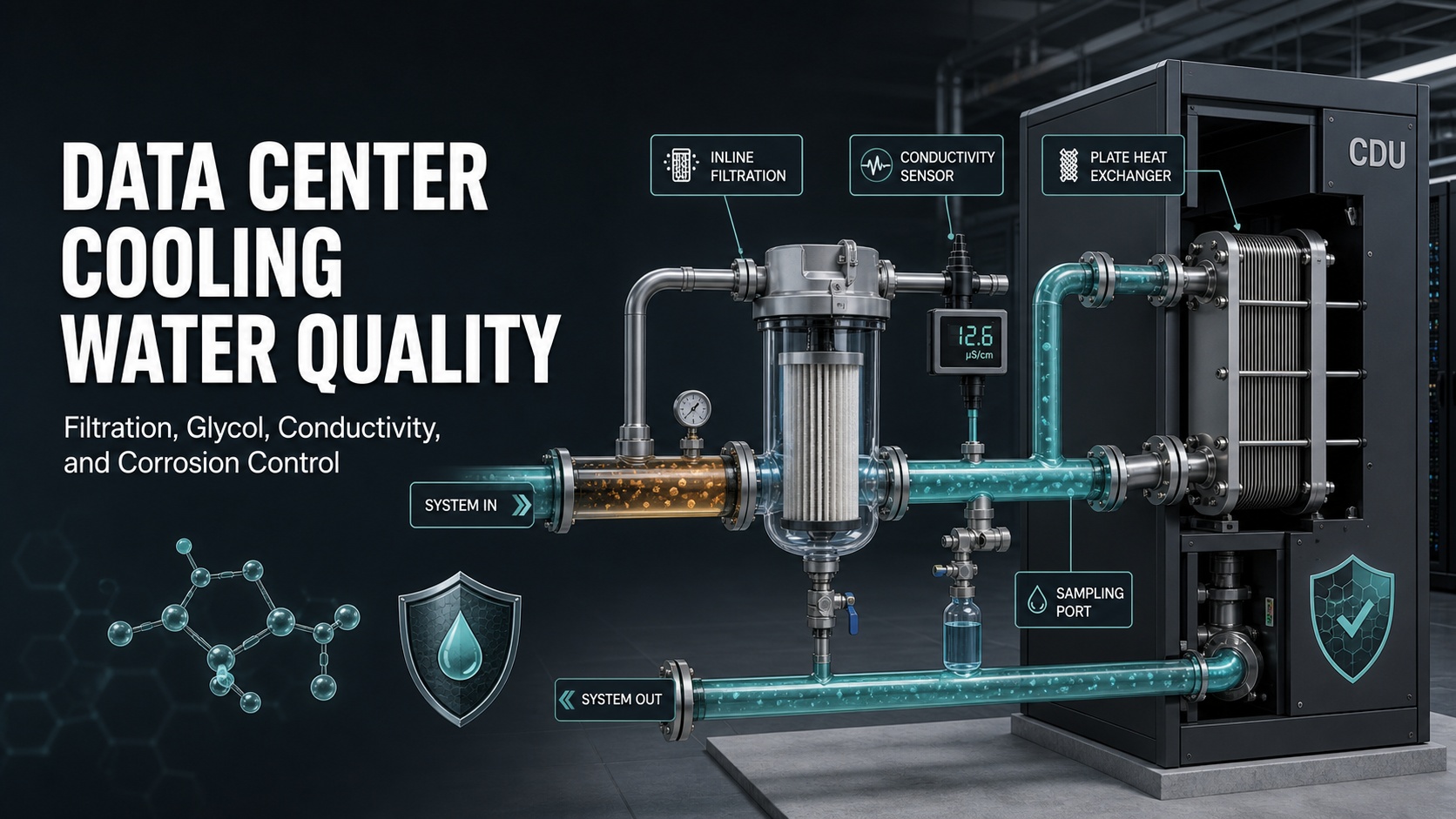
Filtration protects the liquid cooling system from construction debris, corrosion particles, gasket fragments, scale, and other contaminants.
It also creates pressure drop.
This creates a design trade-off. A filter that captures very small particles may protect cold plates more effectively, but it may require more frequent maintenance or create higher pressure loss. A filter with low resistance may not provide enough protection for sensitive heat-transfer components.
Where filtration matters
Filters or strainers may be installed:
At the CDU inlet
On the TCS supply
On the FWS supply
Near sensitive cold plates
Before a plate heat exchanger
At pump suction, where appropriate
In temporary flushing arrangements
The final arrangement depends on the system architecture and equipment requirements.
Clean filter versus loaded filter
The filter pressure drop changes as the filter loads.
The RFQ and commissioning documents should distinguish between:
Clean-filter pressure drop
Normal operating pressure drop
Warning differential pressure
Maintenance threshold
Maximum allowable pressure drop
Flow performance during filter loading
Safe isolation and replacement procedure
A filter differential-pressure sensor is useful because a partially blocked filter may not trigger an immediate low-flow alarm. Instead, the pump may increase speed to maintain flow until it reaches its control limit.
The operator then sees:
Higher pump speed
Higher pump power
Lower remote-branch flow
Increasing supply temperature
Greater CDU pressure drop
The system is still running, but the operating margin is shrinking.
Filtration cannot replace proper flushing. A new loop should be cleaned and flushed before final filling. Otherwise, the first filter service may become a collection point for installation debris that should have been removed during commissioning.
Glycol Concentration Changes Both Protection and Performance
Glycol is often used when the cooling system requires freeze protection or when outdoor piping may experience low temperatures.
The concentration must be selected for the actual site conditions.
Too little glycol may not provide adequate freeze protection. Too much glycol can reduce cooling and increase hydraulic resistance.
A higher glycol concentration typically affects:
Specific heat
Viscosity
Density
Flow rate
Pressure drop
Pump power
Heat exchanger capacity
Cold plate performance
This is important for both glycol concentration and CDU sizing.
A system calculated with pure-water properties may not deliver the expected flow after it is filled with a water-glycol mixture. The difference becomes more significant at lower temperatures because fluid viscosity changes with temperature.
The project should confirm:
Glycol product and formulation
Target concentration
Acceptable concentration range
Freeze-protection requirement
Operating temperature
Refill procedure
Concentration testing method
Compatibility with seals and metals
Corrosion-inhibitor package
Disposal and maintenance requirements
Do not add glycol on site without updating the hydraulic and thermal calculations.
A refractometer or density measurement can help verify concentration, but the test method must match the specific glycol formulation. The measured value should be compared with the manufacturer’s technical data.
Pro Tip: Record glycol concentration during initial filling, after major fluid replacement, and after any significant top-up. A small amount of water or premixed coolant can change the final concentration in a large loop.
Conductivity Is a Trend, Not a Complete Water-Quality Diagnosis
Conductivity is useful because it indicates the presence of dissolved ionic substances in the fluid.
A rising reading may be associated with:
Makeup water
Dissolved salts
Corrosion products
Treatment chemicals
Contamination
Material degradation
Incorrect fluid addition
Conductivity is valuable for trend monitoring, but it should not be treated as a complete water-quality diagnosis.
The same conductivity value may have different meanings in different coolant formulations. A project should define:
Measurement location
Sensor type
Temperature compensation
Sampling method
Normal baseline
Warning threshold
Escalation threshold
Confirmatory laboratory tests
When conductivity changes, operators should also review:
pH
Glycol concentration
Chloride
Sulfate
Hardness
Iron or copper content
Corrosion-inhibitor condition
Filter differential pressure
Fluid appearance
Recent maintenance activity
A single sensor value should not trigger random chemical dosing.
The correct response is to compare the reading with the baseline, review the operating history, and confirm the cause using the approved test method.
Corrosion Control Starts with Material Compatibility
Corrosion is not caused by one variable alone.
It can be influenced by:
pH
Dissolved oxygen
Chloride
Sulfate
Conductivity
Temperature
Glycol chemistry
Corrosion inhibitors
Mixed metals
Electrical grounding conditions
Fluid stagnation
Microbiological activity
A liquid cooling loop may contain stainless steel, copper, aluminum, brass, carbon steel, plastics, elastomers, and plated components. These materials do not have identical corrosion behavior.
Mixed-metal systems can also create galvanic-corrosion risks when the fluid chemistry and electrical conditions allow current flow between dissimilar metals.
The project should create a materials compatibility list covering:
CDU heat exchanger
Pumps
Pipes
Manifolds
Cold plates
Quick disconnects
Valves
Filters
Sensors
Seals and gaskets
Expansion vessels
Flexible hoses
Corrosion control may involve:
Approved coolant chemistry
Corrosion inhibitors
Low-oxygen filling procedures
Correct pH control
Electrical bonding and grounding
Avoiding incompatible metals
Regular fluid sampling
Removing stagnant branches
Maintaining proper filtration
The exact chemical program should come from the coolant and equipment suppliers. Generic chemical dosing without compatibility review can damage seals, sensors, coatings, or heat-transfer surfaces.
Plate Heat Exchanger Fouling Reduces Cooling Margin
A plate heat exchanger transfers heat through thin metal plates. Its performance depends on the heat-transfer surface remaining clean and the fluid reaching the required flow rate.
Fouling can come from:
Scale
Corrosion products
Construction debris
Suspended particles
Biological deposits
Incompatible treatment chemicals
Poor flushing
Incorrect fluid chemistry
Fouling adds thermal resistance.
The system may then show:
Higher TCS supply temperature
Higher FWS return temperature
Increased approach temperature
Reduced cooling capacity
Higher pump speed
Increasing pressure drop
Larger temperature difference between normal and peak operation
The heat exchanger may still appear mechanically sound. There may be no visible leak and no immediate alarm.
This is why approach temperature and pressure drop should be trended together.
| Observed Trend | Possible Cause to Investigate |
| Temperature rises while flow remains stable | Heat exchanger fouling, warmer facility water, or reduced heat-rejection capacity |
| Flow decreases while pressure drop rises | Filter loading, fouling, valve restriction, or pipe contamination |
| Flow fluctuates with unstable pump behavior | Air in the loop, cavitation risk, or intermittent blockage |
| TCS temperature rises while FWS temperature is normal | CDU heat exchanger issue, TCS-side flow restriction, or sensor error |
| Both TCS and FWS temperatures rise | Higher heat load, dry cooler limitation, chiller issue, or facility-side flow problem |
A plate heat exchanger should be selected with a defined fouling assumption and a maintainable cleaning strategy.
The supplier should state:
Design pressure drop
Allowable pressure drop
Design fluid
Maximum operating temperature
Cleaning method
Cleaning frequency guidance
Gasket compatibility
Performance under normal and redundant operation
Commissioning Should Establish a Water-Quality Baseline
Water-quality management begins before the first full-load test.
A practical commissioning sequence should include:
Inspect the installed materials and components.
Confirm the approved coolant and water source.
Flush the piping and equipment as specified.
Remove construction debris.
Pressure-test the loop.
Fill the system using the approved procedure.
Vent high points and remove trapped air.
Confirm glycol concentration where applicable.
Record initial pH and conductivity.
Check filter differential pressure.
Confirm flow and pressure at the CDU.
Verify flow at the remote or worst-case branch.
Confirm leak detection and alarms.
Record TCS and FWS supply and return temperatures.
Establish the initial operating baseline.
The baseline should include:
Coolant type
Glycol concentration
pH
Conductivity
Temperature
Flow rate
Differential pressure
Filter condition
Pump speed
Heat exchanger approach temperature
Fluid appearance
The baseline makes later troubleshooting much easier.
Without baseline data, an operator may know that conductivity is “high” but not know whether it has changed from the original fill condition. The same applies to filter pressure drop, glycol concentration, and heat exchanger approach temperature.
What Buyers Should Put in a CDU RFQ
A CDU RFQ should include water-quality requirements alongside cooling capacity, flow, pressure, and redundancy.
The buyer should provide:
TCS fluid type
FWS fluid type
Water source
Glycol type and concentration
Minimum and maximum operating temperature
Required pH range
Conductivity monitoring requirement
Filtration requirement
Maximum particle size or cleanliness requirement
Material compatibility requirements
Corrosion-control requirements
Maximum pressure drop
Filter differential-pressure limits
Heat exchanger fouling assumption
Sampling ports
Water-quality sensors
Alarm requirements
Maintenance access
Cleaning procedure
Fluid replacement procedure
Warranty and chemical-compatibility conditions
The supplier should provide:
Approved fluid list
Material compatibility statement
Recommended glycol concentration
Required water-quality range
Clean and loaded filter pressure-drop data
Heat exchanger pressure-drop data
Heat exchanger cleaning instructions
Sensor accuracy and calibration requirements
Recommended sampling points
Alarm setpoints
Fluid replacement procedure
Commissioning checklist
FAT and SAT test requirements
Do not accept the phrase “standard water quality” without a defined technical document.
The final requirement should identify who is responsible for:
Fluid procurement
Loop cleaning
Final filling
Chemical testing
Sensor calibration
Filter replacement
Fluid disposal
Warranty review
Common Water-Quality Mistakes
Mistake 1: Filling the loop with untreated water
Untreated water can introduce minerals, particles, oxygen, and biological contaminants.
Mistake 2: Using pure-water calculations for a glycol system
This may underestimate pressure drop and pump power while overestimating heat-transfer performance.
Mistake 3: Treating conductivity as the only water-quality parameter
Conductivity cannot explain every corrosion, contamination, or fouling issue.
Mistake 4: Choosing a filter only by micron rating
The filter must also meet the required flow, pressure-drop, service life, and maintenance conditions.
Mistake 5: Ignoring filter loading
A clean filter may operate correctly while the same filter creates serious restriction after collecting particles.
Mistake 6: Mixing TCS and FWS treatment strategies
The two loops may have different materials, fluids, temperatures, and contamination risks.
Mistake 7: Adding chemicals without compatibility review
Unapproved additives may damage seals, sensors, coatings, pumps, or heat exchangers.
Mistake 8: Skipping the commissioning baseline
Without initial records, it is difficult to tell whether a later problem comes from fluid chemistry, fouling, flow restriction, or sensor drift.
Mistake 9: Forgetting warranty requirements
Some server and CDU warranties require specific coolants, filtration levels, fluid chemistry, or maintenance records.
Final Verdict
Data center cooling water quality directly affects cooling capacity, flow stability, pump energy, heat exchanger performance, and equipment service life.
A reliable program should connect:
Coolant selection → filtration → glycol control → conductivity monitoring → corrosion prevention → heat exchanger maintenance → commissioning data
The goal is not to choose the most chemically complex treatment program.
The goal is to maintain a fluid condition that is:
Compatible with the equipment
Stable at the operating temperature
Clean enough for cold plates and heat exchangers
Resistant to corrosion
Easy to monitor
Practical to maintain
Supported by clear supplier documentation
For AI data centers, water quality should be written into the CDU and cooling-system specification before procurement.
A complete liquid cooling system is not only a CDU, pump, and heat exchanger. It is also the coolant, filter, sensor, sampling plan, maintenance procedure, and acceptance data that keep the system operating over time.
For a project-specific review, explore the ACT-Boxes CDU solution and Modular AI Data Center solution. You can also contact the engineering team with your rack heat load, coolant type, glycol concentration, water-quality requirements, and site conditions.
FAQ
Why is data center cooling water quality important?
Poor coolant quality can increase pressure drop, reduce heat-transfer performance, damage components, load filters, and reduce the long-term cooling margin of the system.
What water quality does a CDU require?
The correct requirements depend on the CDU design, heat exchanger, coolant, materials, server equipment, glycol formulation, and warranty conditions. Buyers should request a written water-quality specification from the supplier.
Does glycol improve liquid cooling performance?
Glycol can provide freeze protection, but a higher concentration can increase viscosity, pressure drop, and pump power while reducing specific heat. The concentration must be selected for the actual site and operating conditions.
What does high conductivity mean in a cooling loop?
High or rising conductivity may indicate more dissolved ionic substances, contamination, treatment chemicals, or corrosion products. Conductivity should be evaluated with pH, glycol concentration, laboratory testing, and operating history.
How can plate heat exchanger fouling be identified?
Possible signs include rising approach temperature, higher supply temperature, increasing pressure drop, reduced cooling capacity, or higher pump speed. Flow, temperature, and pressure trends should be reviewed together.
How often should a liquid cooling loop be tested?
Testing frequency depends on the coolant, system design, site conditions, equipment requirements, and maintenance plan. A baseline should be established during commissioning, followed by risk-based periodic checks and additional tests after fluid changes or abnormal readings.
RESEARCH REFERENCES
ASHRAE, Liquid Cooling Guidelines for Datacom Equipment Centers
https://www.ashrae.org/technical-resources/bookstore/liquid-cooling-guidelines-for-datacom-equipment-centers-second-editionSchneider Electric, Liquid Cooling Solutions for Data Centers
https://www.se.com/ww/en/work/solutions/data-centers-and-networks/liquid-cooling/Alfa Laval, Plate Heat Exchangers
https://www.alfalaval.com/products/heat-transfer/plate-heat-exchangers/Dow, DOWFROST Propylene Glycol-Based Heat Transfer Fluids
https://www.dow.com/en-us/market/mkt-building-construction/sub-building-construction/product-line/dowfrost.htmlHydraulic Institute, Pump System Resources
https://www.pumps.org/ACT-Boxes CDU Product Page
https://blockchain-miner.com/product/cdu/